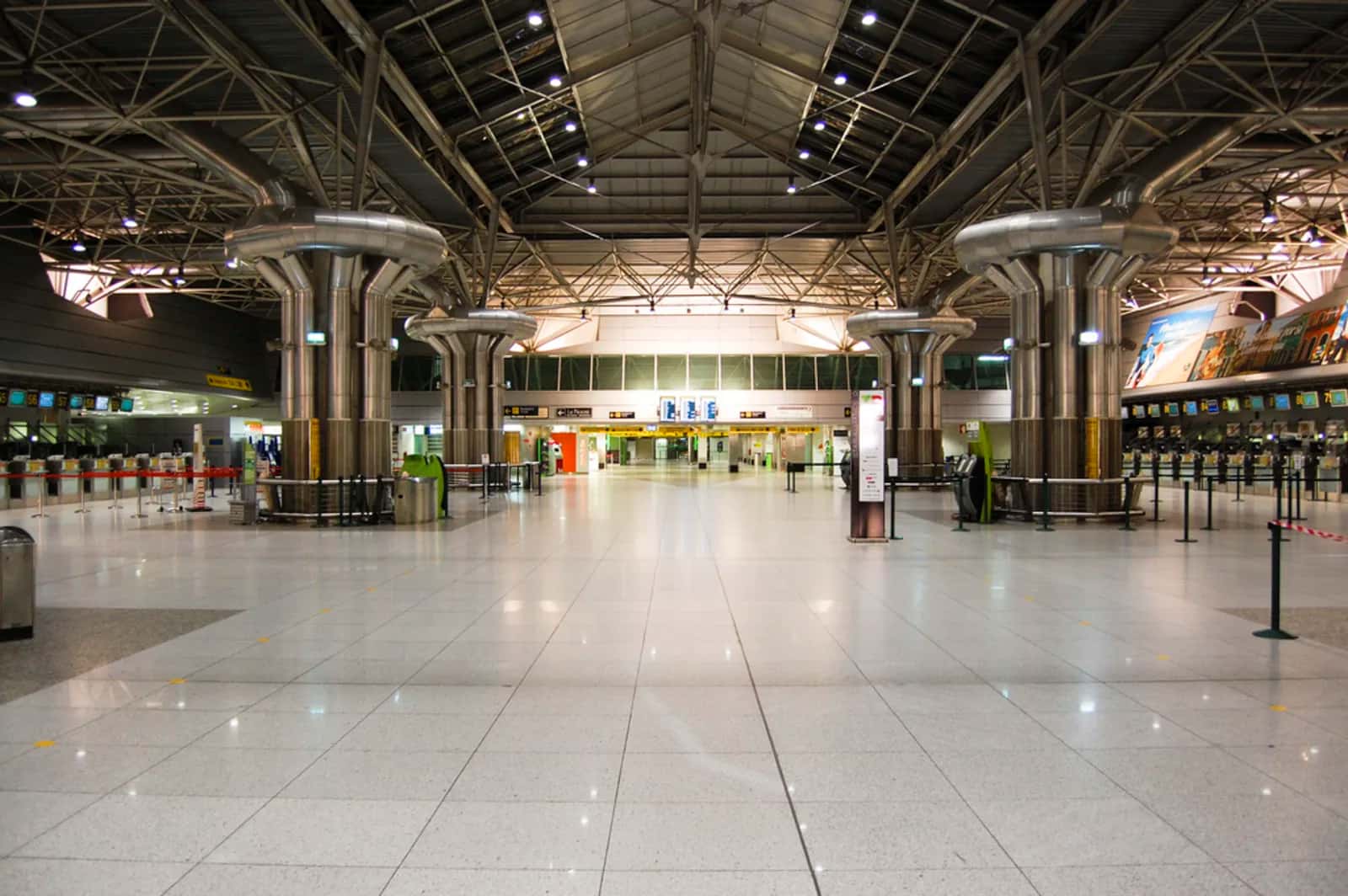
Lisbon Airport (LIS) Terminals
| Terminal | Use | Distance from Metro/Carris bus stops |
|---|---|---|
| Terminal 1 | All scheduled passenger flights (Iberia, TAP, Lufthansa, easyJet, etc) | Direct connection — Metro and Carris bus stops are here |
| Terminal 2 | Low-cost departures only (Ryanair some routes, Wizz Air, transavia) | Free shuttle bus from T1 (every 12–20 min, ~7 min ride) |
T2 is for departures only. All arrivals → T1. Check your boarding pass for the correct terminal before heading to LIS.
Lisbon Airport Terminals — A Complete Guide to T1 and T2
Humberto Delgado Airport in Lisbon (LIS, ICAO: LPPT) is Portugal's largest and busiest airport, serving as the principal gateway to the country and the main hub for TAP Air Portugal. As the airport has grown to handle more than 30 million passengers a year, its terminal infrastructure has evolved into a two-building configuration that handles the full range of commercial aviation, from major intercontinental long-haul flights to low-cost European point-to-point services. Understanding which terminal corresponds to your flight, how the two buildings relate to each other, and what facilities each one offers is essential for a smooth experience at Lisbon Airport (LIS).
Unlike some of Europe's larger hub airports with sprawling multi-terminal complexes, Lisbon's setup is relatively compact. Terminal 1 handles the majority of operations, while Terminal 2 is a smaller satellite building dedicated to low-cost carriers' departures. The two are connected by a free shuttle bus service that runs continuously throughout operating hours, and the journey between them takes only a few minutes. While the layout is straightforward in principle, several practical details — terminal-specific airline assignments, the differing arrival and departure flows, the shuttle frequency, and the variation in available facilities — can affect how you plan your time at the airport.
This guide walks through everything you need to know about Lisbon Airport's terminals, with detailed coverage of T1 and T2's specific functions, the layout and gate structure of each building, the practical realities of moving between them, and the on-the-ground details that travelers actually use — check-in procedures, security flow, boarding gate logistics, dining and retail options, and lounge access. Whether you're flying TAP long-haul, hopping on a Ryanair flight to Manchester, or meeting an arriving passenger, this overview is designed to help you navigate the terminals with confidence.
Overview: The Two-Terminal Configuration at Lisbon Airport
Lisbon Humberto Delgado Airport operates with two passenger terminals: Terminal 1 (T1) and Terminal 2 (T2). T1 is the main and original terminal, handling the vast majority of flights — both Schengen and non-Schengen, both arrivals and departures, and including all flights operated by full-service airlines. Terminal 2, opened in 2007, was designed as a dedicated facility for low-cost carriers, and its operation is structured differently from T1. T2 handles only departures for low-cost airlines; arrivals from those same airlines all funnel back through T1's arrivals halls.
This asymmetric arrangement — where T2 is departures-only and T1 receives all arrivals regardless of airline — is one of the most important things to understand about the airport. It means that travelers flying with Ryanair, Wizz Air, or other low-cost operators will go through different terminals at the start and end of their trip. Departing, you'll head to T2; returning, you'll arrive back at T1. This is by design and works well in practice, but it can surprise first-time visitors who expect the same building for both directions.
The two terminals are about 1.5 kilometers apart along the airport perimeter, connected by an internal road and a dedicated shuttle bus service. The shuttle is free for passengers and runs frequently enough — typically every 5 to 15 minutes during peak hours — that transfers between the buildings rarely cause significant inconvenience. The journey itself takes 3 to 7 minutes depending on traffic conditions on the airport road. For more on planning your overall airport experience, see our broader Lisbon Airport guide.
Terminal 1 (T1) — The Main Hub
Terminal 1 is the principal terminal at Lisbon Airport and where you will spend your time if you're flying with TAP Air Portugal, any Star Alliance carrier, most SkyTeam and Oneworld members, and a wide range of other full-service airlines. It handles both Schengen flights (within the European passport-free zone) and non-Schengen international flights, including all transatlantic services to North and South America, flights to Africa, the Middle East, and Asia. The building is laid out across multiple levels, with departures, arrivals, and ground transport access organized in a generally intuitive manner.
T1's check-in halls are located on the upper level, with extensive counter capacity for the airlines that operate from the terminal. TAP Air Portugal occupies a significant share of the check-in space, given its role as the airport's home carrier. Self-service kiosks are widely available across the airline counters, and bag drop-off facilities support the increasing share of travelers who check in online. The departures security control is on the same level, after which passengers proceed into the airside concourse where shopping, dining, and lounge facilities are concentrated.
The terminal's gates are organized into Schengen and non-Schengen zones, separated by passport control for travelers entering or leaving the Schengen area. Most of the long-haul gates are at the eastern end of the building, with shorter European routes departing from the central and western sections. Arrivals are handled on the lower level, with separate paths for Schengen and non-Schengen passengers, and a unified baggage claim area that channels travelers toward customs and the public arrivals hall. For specific guidance on what to expect during arrival, see our coverage of Lisbon Airport arrivals.
T1's amenities include multiple restaurants and cafes, a substantial duty-free shopping zone, currency exchange counters, ATMs, pharmacies, banks, and information desks. Free WiFi is available throughout the terminal. Lounges include the TAP Premium Lounge for first and business class travelers and Star Alliance gold members, the Blue Lounge for lower-tier premium passengers, and the ANA Lounge available to passengers via Priority Pass and similar programs.
Terminal 2 (T2) — The Low-Cost Carrier Hub for Departures
Terminal 2 was opened in 2007 specifically to handle the rapidly growing low-cost airline traffic at Lisbon Airport. Today, T2 is used by Ryanair, Wizz Air, Vueling, Transavia, and several other low-cost operators for their departing flights. The building is significantly smaller than T1 and operates with a more streamlined model — fewer counter positions per square meter, simpler retail and dining offerings, and a faster overall passenger flow designed to match low-cost carriers' efficiency-focused operations.
The fundamental thing to understand about T2 is that it handles departures only. When you fly out of Lisbon on Ryanair to Dublin, Wizz Air to Warsaw, or Vueling to Barcelona, you check in and board at Terminal 2. But when you arrive back in Lisbon on the return flight from any of those carriers, you will arrive at Terminal 1, not T2. This split serves operational purposes for the airlines and the airport, and it means departing and returning travelers experience different terminal facilities on different legs of their trip.
For first-time visitors flying with low-cost carriers, this can be confusing. Make sure that when you depart from Lisbon, you go to T2 — checking in at T1 will lose you valuable time. The shuttle bus runs frequently, but if you arrive at the wrong terminal, you'll need 10 to 20 additional minutes to reach the correct one, plus the time to clear security at T2 once you're there. The signage at the airport's main approach roads clearly directs traffic to T1 or T2, but it's worth noting your terminal in advance from your boarding pass or airline confirmation.
T2 has its own check-in halls, security control, and gate areas. The terminal's facilities are simpler than T1's — fewer dining options, smaller duty-free area, and no full-service lounges. There is, however, a basic café-and-bar setup, several convenience-style retail outlets, water and sandwich kiosks, and free WiFi. For travelers used to T1's more extensive offerings, T2 can feel somewhat spartan, but it generally meets the practical needs of a quick low-cost departure. For broader context on getting between the two buildings, see Lisbon Airport transfers.
The Free Inter-Terminal Shuttle Bus
The shuttle bus connecting T1 and T2 is a fundamental part of how Lisbon Airport works for low-cost carrier passengers and anyone moving between the buildings for any reason. The shuttle is free and runs continuously during operating hours — generally from very early morning (around 5:00 AM) to late at night, matching the pattern of flight operations at both terminals. There is no fare and no ticket required; you simply board the bus at the designated stop outside either terminal.
The journey takes roughly 3 to 7 minutes depending on traffic. Buses arrive every 5 to 15 minutes at peak times and somewhat less frequently during off-peak periods. There is luggage space on the shuttle, but for travelers with large or numerous bags, the boarding process can be slower. If you're transferring between terminals with significant luggage, allow extra time and don't try to time your transfer too tightly — a 30-minute buffer between leaving one terminal and being checked in at the other is reasonable, especially during busy hours.
The shuttle stops are clearly marked at both terminals. At T1, the stop is on the level closest to the public road outside the building. At T2, the stop is similarly accessible from the main building entrance. Real-time digital displays at both stops show the next bus's expected arrival, and announcements via the airport's announcements system also indicate shuttle departures.
For travelers who prefer not to take the shuttle — for example, those who want to walk between terminals or take a taxi for any reason — note that walking is not generally feasible due to the layout of the airport's roadways and the absence of pedestrian paths between the two buildings. A taxi is possible but unnecessary; the shuttle is faster and free.
Schengen and Non-Schengen Sectors at T1
Terminal 1 is divided into Schengen and non-Schengen sectors after security control. Schengen flights — to other countries within the European Schengen passport-free area — depart from one section of the terminal, while flights to non-Schengen destinations (including the UK, Ireland, the United States, Canada, Brazil, and other international destinations) depart from a separate area. The two sectors are connected by passport control, which is a key bottleneck during busy departure periods.
If your flight is to a non-Schengen destination, you will need to clear passport control before reaching your gate. Plan extra time for this — during peak hours, the passport control queues can be substantial. EU and Portuguese citizens have access to e-gates that significantly speed up the process, but non-EU travelers go through staffed counters. The same logic applies in reverse on arrival: passengers arriving from non-Schengen origins go through passport control, while Schengen arrivals proceed directly to baggage claim or transit.
The gate areas in both sectors include duty-free shopping (more extensive in the non-Schengen area), restaurants, lounges, and seating areas. Walking distances from passport control to the most distant gates can be 5 to 15 minutes, depending on the gate, so allow walking time when planning your departure timing. Display screens throughout the terminal provide real-time gate information and any updates to your flight's status.
For passengers connecting between flights at T1, the airline transfer process is generally straightforward, with airline staff at most major carriers providing guidance for connection routes. For specifics on departure procedures and timing, see our Lisbon Airport departures page.
Check-In Counters and Self-Service Kiosks
Check-in at Lisbon Airport varies by terminal and airline, but the general structure is consistent: each airline has dedicated counters in the appropriate terminal's check-in hall, supplemented by self-service kiosks for travelers without checked baggage or those who have already completed online check-in. Most major airlines now encourage online check-in well in advance, with bag drop-off counters at the airport for travelers with checked bags.
At T1, TAP Air Portugal occupies the largest share of check-in capacity, with multiple counters running for short-haul European, transatlantic, and African flights. Other airlines — Lufthansa, Air France, KLM, British Airways, American Airlines, United, and many others — have their dedicated zones within the terminal. Self-service kiosks are clustered near the airline counters and accept boarding pass printing, baggage tag printing for many carriers, and seat selection.
At T2, the check-in halls are smaller and serve fewer airlines, primarily Ryanair, Wizz Air, Vueling, and similar operators. The ratio of self-service to staffed counters is higher at T2, reflecting the low-cost airlines' reliance on online check-in. Ryanair, in particular, charges fees for using staffed bag-drop counters in some markets, so completing online check-in and using kiosks where possible is the standard approach for cost-conscious travelers.
Check-in opening times depend on the airline and route. Long-haul international flights typically open 3 hours before departure, while Schengen and short-haul European flights generally open 2 hours before. Counters close 60 minutes before departure for international and 45 minutes before for Schengen flights. Always confirm specific cut-off times with your airline, as some carriers — particularly low-cost operators — strictly enforce earlier closures.
Security Control — Procedures and Fast Track
Security control at Lisbon Airport follows standard EU regulations: liquids in containers up to 100 ml in a transparent 1-liter resealable bag, laptops and large electronics removed from carry-on bags, and standard restrictions on prohibited items. The procedures are similar to other major European airports, and the equipment is up to current EU standards. Some lanes at T1 have begun the rollout of newer CT (computed tomography) scanners that allow liquids and laptops to remain in bags, though this is not yet uniform across the airport.
Wait times at security vary considerably by terminal and time of day. T1's security control can experience long queues during peak departure hours, particularly for non-Schengen flights when the morning long-haul wave departs. T2's security tends to move more quickly, reflecting the smaller terminal and the operationally efficient low-cost carrier model. Allow at least 30 to 45 minutes for security during peak times, with longer buffers for international flights from T1.
Fast-track security lanes are available at T1 for premium-cabin passengers, frequent-flyer status holders eligible through their airline alliance, and travelers who have purchased fast-track access. The fast-track lanes are clearly marked near the regular security control areas and typically save 15 to 30 minutes during peak periods. T2 does not generally have fast-track lanes, given the terminal's overall throughput design.
Travelers requiring assistance — those with mobility issues, families with young children, or passengers with medical devices — can request priority access at the security entrance. Inform the staff at the entry, and they will direct you to an appropriate lane. The airport's assistance program also coordinates priority security for passengers who have requested mobility support in advance.
Boarding Gates and Waiting Areas
Once through security at either terminal, passengers proceed to their assigned boarding gates. Gate assignments are usually published 30 to 45 minutes before boarding for short-haul flights and slightly earlier for long-haul. Display screens throughout both terminals show real-time gate information and any changes, and airline apps typically provide notifications about boarding times and gate changes.
T1's gate areas are spread across the terminal, with both Schengen and non-Schengen gates having dedicated waiting areas. The gate facilities include seating, charging stations at most points, free WiFi throughout the airport, and views of the airfield through large windows. Some of the long-haul gates are equipped with comfortable lounge-style seating, recognizing that intercontinental travelers often have extended pre-departure waits.
T2's gates are arranged in a more compact layout, reflecting the smaller terminal footprint. Walking distances from security to the gates are shorter than at T1, but the seating density is higher and the terminal can feel more crowded during peak departure periods. Boarding for low-cost flights often involves bus transfers to remote-stand aircraft, where passengers board a bus that takes them to the parked airplane. Bus boarding adds 5 to 10 minutes to the boarding process, so factor this in if your gate is a bus gate.
For passengers with longer waits before boarding, both terminals offer access to nearby restaurants and shops directly from the gate areas. T1's airside dining and retail are more extensive, but T2 has the basics covered for short waits. Family seating areas and child-friendly spaces are available at both terminals, with the larger and more developed facilities at T1.
Restaurants and Cafes by Terminal
Dining options at Lisbon Airport reflect Portuguese culinary culture and international airport dining standards. T1 has the broader and more extensive restaurant offering, while T2's dining is more limited but still functional. Both terminals include landside (before security) and airside (after security) options, with the airside selection generally larger.
At T1, you can find Portuguese specialties — pastéis de nata at multiple bakery-cafés, traditional Portuguese sandwiches and small plates at sit-down restaurants, and quick-service options serving local favorites. International chains like Starbucks, McDonald's, Burger King, and various sandwich shops also operate at T1. Several restaurants offer full-service Portuguese dining with regional dishes, suitable for travelers who want a meaningful pre-flight meal. The duty-free area also has wine and Portuguese specialty food retailers, where travelers often stock up on port wine, olive oil, and traditional sweets.
T2's dining is more streamlined — fewer restaurants, smaller selections, and a focus on quick service. Expect basic café options, sandwich bars, and one or two simple sit-down spots. Pricing at airport restaurants is typically higher than equivalent venues outside the airport, but the variety at T1 ensures most travelers can find something acceptable. Children's menus are available at most full-service restaurants, and several venues at T1 have high chairs.
For travelers with dietary restrictions — vegetarian, vegan, gluten-free, kosher, halal — T1 generally offers more options. T2's smaller dining choices may have fewer specialty options, so plan accordingly if you have specific dietary needs and a long wait at T2.
Shopping and Duty-Free
Lisbon Airport's retail offering is concentrated in T1, where the duty-free area is substantial and includes the standard categories — alcohol, tobacco, perfumes, cosmetics, and confectionery — alongside Portuguese specialty products like port wine, olive oil, regional cheeses (where allowed by destination customs), traditional sweets, and ceramics. Spanish and Portuguese fashion brands have presence in T1's retail concourse, alongside international labels.
The duty-free in T1 covers both the Schengen and non-Schengen sectors, with non-Schengen shopping providing the most substantial savings on alcohol and tobacco for travelers heading to non-EU destinations. Schengen-area travelers do not benefit from the same duty-free pricing, since intra-Schengen travel is treated similarly to domestic travel for tax purposes.
T2's retail is much more limited — typically a small convenience-style outlet for travel essentials, water, sandwiches, and basic items. There is no major duty-free zone at T2, given the terminal's design focus on rapid throughput for low-cost departures. Travelers wanting to do meaningful airport shopping should plan to do it at T1, either before departure if their flight is from T1 or by allocating time at T1 before transferring to T2 for a low-cost departure.
VAT refunds for non-EU travelers are processed at dedicated VAT-refund counters at T1. Shopping at qualifying retailers within the EU and obtaining the appropriate paperwork is a standard process, though the specifics depend on the retailer and the destination country's customs rules.
Lounges Available in Each Terminal
Lounge access at Lisbon Airport is concentrated at T1, where TAP Air Portugal and Star Alliance partner airlines maintain extensive lounge facilities. The TAP Premium Lounge is the most prominent, offering full food and beverage service, work areas, showers, and rest spaces for first-class, business-class, and Star Alliance Gold passengers. The lounge is widely regarded as one of the better airline lounges in southern Europe, with a focus on Portuguese cuisine and wines.
The Blue Lounge serves a different segment — primarily mid-tier premium passengers and certain frequent flyer status holders. The ANA Lounge (operated by ANA Aeroportos de Portugal, the national airport operator) is available to travelers with Priority Pass and similar lounge programs, providing pay-per-use access for those without dedicated airline lounge eligibility. Walk-in access to ANA Lounge is also possible at standard fees.
T2 does not have full-service airline lounges. There are some pay-per-use seating areas with light refreshments, but these don't approach the comfort or service of T1's lounges. Travelers wanting lounge experience should arrange their itinerary to access T1's lounges where possible.
For travelers without lounge access, T1's public seating areas include charging stations, comfortable seating, and views of the airfield. T2's public seating is more basic. Both terminals offer free WiFi.
Family Services and Accessibility
Lisbon Airport provides family-oriented services and accessibility features across both terminals, with the more extensive provisions at T1. Family rooms with diaper-changing facilities, breastfeeding areas, and bottle-warming services are available at T1. Children's play areas exist in T1 as well, providing space for younger travelers during longer waits. T2's family services are more limited but adequate for shorter low-cost carrier transit.
Accessibility services at the airport are coordinated through ANA's program, which is similar to AENA's accessibility program in Spain — free assistance for travelers with reduced mobility, mobility-impaired passengers, visually or hearing-impaired travelers, or those who simply need extra support due to age or temporary conditions. The service is requested through the airline at least 48 hours in advance, though same-day assistance is generally accommodated.
Trained accessibility staff guide passengers through check-in, security, immigration, and to the gate. For arriving passengers, similar assistance helps with disembarkation, immigration, baggage claim, and onward transport. Both terminals have accessible parking, accessible restrooms, and audio/visual announcement systems for travelers with sensory impairments.
Service animals are welcome at both terminals, with relief areas available at appropriate locations. For specific accommodation needs, contacting the airport's accessibility services in advance ensures the smoothest experience.
Practical Tips for Navigating Between Terminals
Successfully navigating Lisbon Airport's two-terminal structure comes down to preparation and time buffers. The single most important step is verifying your departure terminal in advance — your boarding pass shows it clearly, and the airline confirmation will indicate it. Show up at T1 when your flight departs from T2, and you'll lose at least 20 to 30 minutes recovering, which is enough to miss boarding for a low-cost flight with strict cut-offs.
Allow generous time for the inter-terminal shuttle. Even though the journey itself is short, the cumulative time — walking from your previous arrival point to the bus stop, waiting for the shuttle, the journey itself, walking into the destination terminal, and clearing security — easily totals 30 to 45 minutes during peak hours. For connecting flights between terminals (rare given the asymmetric structure but possible for arrivals at T1 and departures at T2), allow 90 to 120 minutes.
Use the airport's official information systems for real-time updates. The ANA app and the airport's website both provide flight status, gate assignments, and shuttle information. Free WiFi throughout both terminals makes accessing this information straightforward.
If you're parking at the airport, choose your parking based on your departure terminal — there are dedicated parking facilities serving each. See our coverage of Lisbon Airport parking services for the full breakdown of options. If you're staying at one of the hotels near Lisbon International Airport the night before an early flight, confirm with the property whether their shuttle serves both T1 and T2, or whether you'll need to use the inter-terminal shuttle to reach T2 from a hotel that drops you at T1.
For travelers researching flight options before booking, the choice between full-service carriers (operating from T1) and low-cost carriers (departing from T2) is partly a terminal-experience choice as well as a price and service one. Full-service flights from T1 typically offer the more comprehensive airport experience; low-cost flights from T2 prioritize speed and efficiency over amenities. Knowing what to expect from each terminal helps set realistic expectations for the airport portion of your trip. For more on which carriers operate from which terminal, see our airlines at Lisbon Airport page.
Have questions about your terminal? Contact us for help planning your route.
You May Also Like
- Lisbon Airport Guide
- Airlines at Lisbon Airport
- Lisbon Airport Arrivals
- Lisbon Airport Transfers
Which Terminal Is My Airline at Lisbon Airport? (2026 Table)?
The fastest way to answer this question: Lisbon Airport publishes a short, official list of airlines that depart from Terminal 2 — Eurowings, Norwegian, Ryanair, Transavia, Volotea, Vueling and Wizz Air. If your airline is not one of those seven, you depart from Terminal 1. And no matter who you fly with, you always arrive at Terminal 1, because T2 has no arrivals facilities at all. The table below covers the airlines passengers ask about most.
| Airline | Departures from | Arrivals at |
|---|---|---|
| TAP Air Portugal | Terminal 1 | Terminal 1 |
| easyJet | Terminal 1 | Terminal 1 |
| Ryanair | Terminal 2 | Terminal 1 |
| Wizz Air | Terminal 2 | Terminal 1 |
| Vueling | Terminal 2 | Terminal 1 |
| Transavia | Terminal 2 | Terminal 1 |
| Volotea | Terminal 2 | Terminal 1 |
| Norwegian | Terminal 2 | Terminal 1 |
| Eurowings | Terminal 2 | Terminal 1 |
| Lufthansa | Terminal 1 | Terminal 1 |
| British Airways | Terminal 1 | Terminal 1 |
| Iberia | Terminal 1 | Terminal 1 |
| Air France | Terminal 1 | Terminal 1 |
| KLM | Terminal 1 | Terminal 1 |
| SWISS | Terminal 1 | Terminal 1 |
| Brussels Airlines | Terminal 1 | Terminal 1 |
| Turkish Airlines | Terminal 1 | Terminal 1 |
| Emirates | Terminal 1 | Terminal 1 |
| United Airlines | Terminal 1 | Terminal 1 |
| Delta Air Lines | Terminal 1 | Terminal 1 |
| Air Canada | Terminal 1 | Terminal 1 |
| LATAM Airlines | Terminal 1 | Terminal 1 |
| SATA Azores Airlines | Terminal 1 | Terminal 1 |
A note on easyJet, because it causes more confusion than any other carrier here: easyJet departs from Terminal 1, even though it is a low-cost airline. Older guides still place it at T2, but the current official terminal allocation keeps all easyJet check-in and boarding at T1. If someone tells you to go to T2 for an easyJet flight, they are working from outdated information.
Terminal assignments do change occasionally, so treat this table as a reliable starting point rather than a substitute for your boarding pass. Check the terminal printed on your boarding pass or shown in your airline's app on the day of travel, and if in doubt, confirm against the official Terminal 2 page of Lisbon Airport, which lists the current T2 carriers.
If you do need T2, the free shuttle bus leaves from the Departures kerb of each terminal every 12 minutes between 03:30 and 00:30, and the ride takes about 3 minutes. T2 is closed overnight between 00:30 and 03:30.
Quick answers: airline and terminal questions
Which terminal is TAP Air Portugal at Lisbon Airport?
Terminal 1, for both departures and arrivals. TAP is the airport's largest carrier and all of its operations, including TAP Express regional flights, run through T1.
Which terminal is Ryanair at Lisbon Airport?
Ryanair departs from Terminal 2. Arriving Ryanair flights land at Terminal 1, like every other airline.
Which terminal is easyJet at Lisbon Airport?
Terminal 1 — not T2. easyJet is the main exception to the "low-cost means T2" assumption at Lisbon.
Does Terminal 2 handle any arrivals?
No. T2 is a departures-only building. Every arriving passenger, on every airline, exits through Terminal 1.
My boarding pass doesn't show a terminal — how do I know where to go?
Apply the seven-airline rule: Eurowings, Norwegian, Ryanair, Transavia, Volotea, Vueling and Wizz Air depart from T2; everyone else departs from T1. When unsure, check your airline's app or the flight status page on the day of departure.