Lisbon Airport Departures — A Complete Guide for Travelers
Departing from Lisbon Airport (LIS) — officially Humberto Delgado Airport, also known as Lisbon Portela — is, for most travelers, a manageable experience that benefits significantly from a little preparation. Located only seven kilometers from central Lisbon, LIS is one of Europe's most centrally-positioned major airports, which is both a convenience and a constraint: the airport handles increasing passenger volumes (around 35 million annually in recent years) within a footprint that was originally designed for far less. Knowing how the departures process works, when to arrive, and which terminal handles your flight makes the difference between a smooth start to your journey and an unnecessarily stressful one.
This guide is for travelers about to depart from Lisbon and want a clear picture of what to expect — terminal assignments, security and check-in expectations, boarding procedures, and what to do if your flight is delayed or cancelled. The goal is to remove the uncertainty that turns a routine departure into a source of avoidable anxiety, and to help you make the most of the time you spend at LIS before your flight.
What follows applies across all categories of departures from Lisbon: domestic Portuguese flights to the islands and other regional destinations, Schengen-area flights within Europe, and non-Schengen international flights to North America, South America, Africa, the Middle East, and Asia. Each category has slightly different procedures and timing, and identifying which one applies to your trip is the first step toward an organized departure.
What is Departing from Humberto Delgado Airport?
Lisbon's Humberto Delgado Airport operates as a hub airport with a substantial volume of connecting traffic alongside originating and terminating passengers. TAP Air Portugal, the country's flag carrier, uses Lisbon as its primary base and operates an extensive network connecting Europe with Brazil, the United States, Canada, and several African destinations including Mozambique, Angola, and Cape Verde. Star Alliance partners route through LIS to take advantage of these connections, particularly for travelers heading between Europe and the Portuguese-speaking world.
Departures from Lisbon are split between two physical buildings: Terminal 1 (T1), the main terminal, which handles the great majority of flights including all TAP and Star Alliance operations, all non-Schengen long-haul departures, and most Schengen flights from full-service carriers; and Terminal 2 (T2), a smaller building dedicated almost entirely to low-cost European departures, primarily Ryanair, easyJet, Wizz Air, Vueling, and similar airlines. Understanding which terminal your flight uses is the most important single piece of preparation, because the buildings are physically separate and switching between them at the last minute is stressful and time-consuming.
The airport's compact footprint relative to its passenger volume means that peak periods can produce noticeable congestion, particularly at security control and at certain check-in counters. The infrastructure is generally well-managed, but it is not as spacious as comparable hubs like Madrid, Frankfurt, or Charles de Gaulle. Building extra time into your departure plan accounts for this comfortably and reduces stress when peaks happen to coincide with your flight.
Live Departures Information — Where to Check
The most reliable source for real-time departure information at LIS is ANA Aeroportos de Portugal, the airport operator. Their official website (ana.pt) and their mobile app provide live status data including gate assignments, scheduled and actual departure times, delay codes, and any disruption messages. The app is free, available in multiple languages including English, Portuguese, Spanish, and French, and is the recommended tool for tracking flights in the hours leading up to departure.
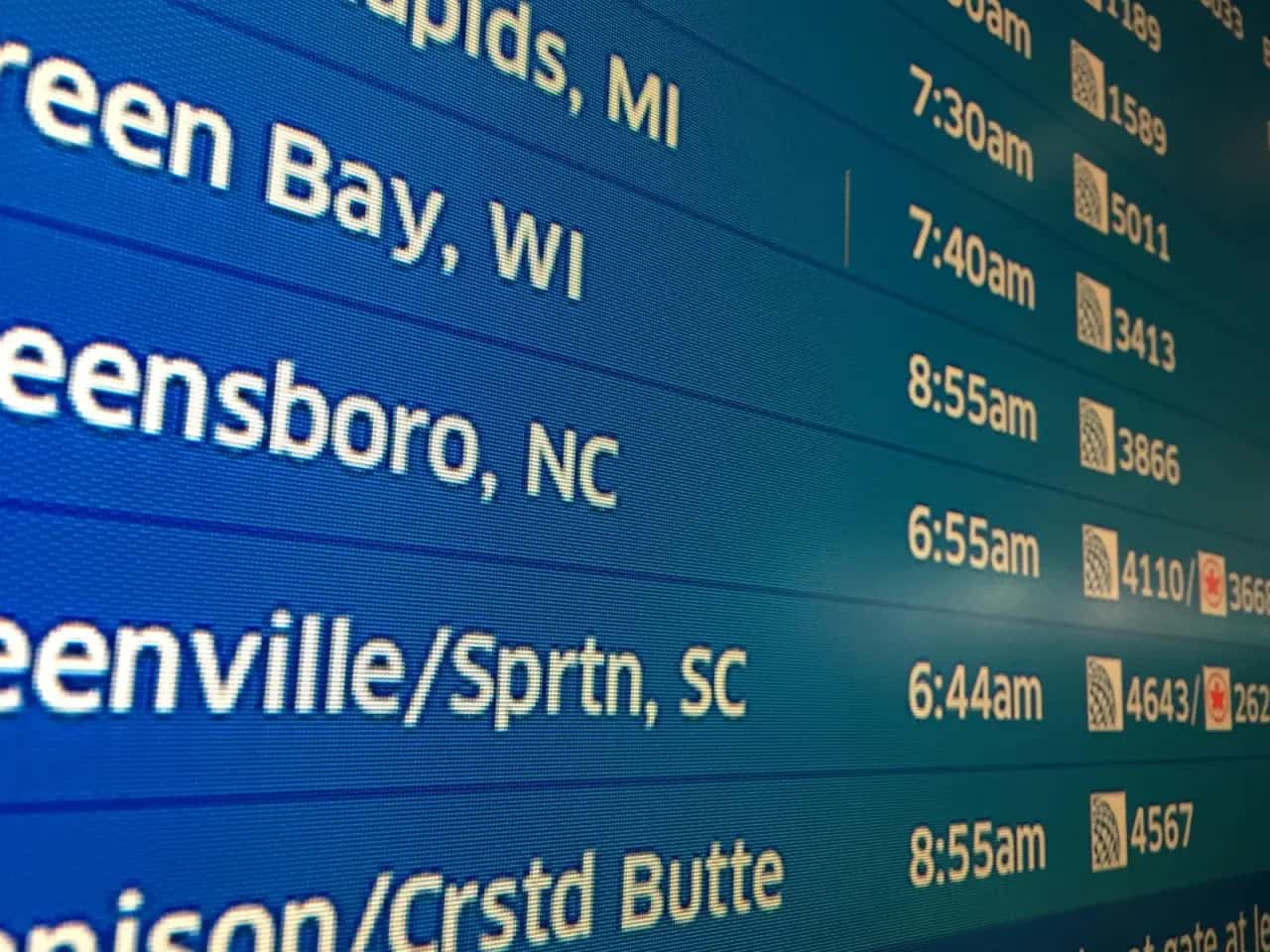
Inside the terminals, large information displays distributed throughout the public and airside areas show the same data in real time. The screens typically display the next several hours of flights sorted by time, with airline, destination, flight number, status, and gate (when published). Status indicators include "Check-in," "Boarding," "Last call," "Departed," and various delay codes. Gates are usually published 30–45 minutes before boarding for short-haul flights and somewhat earlier for long-haul international departures.
Each airline maintains its own real-time information through its app and website, which often provides slightly earlier notification of changes than the airport-wide systems. For peace of mind, set up notifications through both your airline's app and ANA's app, so any change reaches you through at least one channel before you arrive at the airport. TAP's app is particularly polished and useful for travelers flying with the flag carrier.
Third-party flight tracking services (FlightRadar24, FlightAware, Google Flights status) draw on the same underlying data and are useful for context, particularly when delays propagate from the inbound aircraft's previous flight. They should not be your only source for time-critical information, however, since data feeds can lag.
How Early to Arrive — Schengen vs International, Peak Hours?
Recommended arrival times at Lisbon vary by flight type, terminal, and time of day. For Schengen flights — those staying within the Schengen passport-free area, which includes most of mainland Europe — arriving 90 minutes before departure is generally sufficient. The Schengen flow skips passport control on departure, which removes one step and shortens the overall journey from check-in to gate.
For non-Schengen flights, including all flights to the United Kingdom, Ireland, the Americas, Africa, the Middle East, and Asia, arriving 2.5 to 3 hours before departure is the standard recommendation. Long-haul flights from Terminal 1 in particular benefit from earlier arrival, because the post-security walk to international gates can be substantial and security queues during peak hours can produce significant waits.
Peak departure periods at LIS are typically the very early morning (06:00–08:00, when many TAP and Iberia connections push out for European business travel), late morning (10:30–12:30), and early evening (17:00–19:30, when the long-haul transatlantic departure wave begins). Lines at security and check-in can be considerably longer during these windows, especially on Mondays, Fridays, and Sundays. If your flight is during a peak hour, add 30 minutes to your buffer and aim to arrive 3 hours before international departures and 2 hours before Schengen ones.
Lisbon's tourist seasonality also matters. The summer months (June through September) and the Christmas/New Year period bring substantially higher passenger volumes throughout the day. Easter is similarly busy. During these high seasons, the security and check-in queues that would be 15 minutes off-peak can swell to 45 minutes or longer, and the buffer you allow should reflect that.
Departure Terminals — Which Terminal for Which Flight
Knowing which terminal handles your departure is essential at LIS because the two buildings are physically separated and require either a free shuttle bus or a short taxi ride between them. The shuttle is reliable but takes 8–12 minutes including walking time, and you do not want to be making that journey 30 minutes before your scheduled departure.
Terminal 1 (T1), the main terminal, handles the great majority of flights at LIS. This includes all TAP Air Portugal departures regardless of destination, all Star Alliance partner flights (Lufthansa, Swiss, Austrian, Brussels Airlines, Turkish Airlines, United, Air Canada, Avianca, COPA, Singapore Airlines, and others), all SkyTeam and Oneworld flights operating from Lisbon, and most other full-service carriers. Long-haul flights to the Americas, Africa, the Middle East, and Asia all depart from T1.
Terminal 2 (T2) is smaller and dedicated almost entirely to low-cost European departures. The main carriers operating from T2 are Ryanair, easyJet, Transavia, Wizz Air, and Vueling, with destinations across the European Union and the United Kingdom. Importantly, T2 handles departures only — arrivals from these same carriers come into T1 like everyone else, and there is no border control or baggage facility at T2 designed for incoming flights.
The free inter-terminal shuttle bus runs continuously between T1 and T2 with a frequency of approximately every 10 minutes during operational hours. The journey takes around 5 minutes plus the time spent waiting and walking to the pickup point. If you are arriving by Metro, taxi, or car, your driver can drop you directly at the correct terminal — confirm in advance which terminal your flight uses to avoid the inconvenience of starting at the wrong building.
Always verify your terminal on your boarding pass or via the ANA flight status page before traveling to the airport. Operational changes are uncommon but do occur, and the consequences of arriving at the wrong terminal during a tight pre-flight window are significant.
Check-in Procedures — Counters, Online Check-in, Kiosks
Most airlines at LIS offer online check-in, which typically opens 24 to 48 hours before departure depending on the carrier. Online check-in is the recommended option for travelers without checked baggage and significantly shortens the airport process. After completing online check-in, you receive a digital boarding pass on your phone (or you can print it), and you proceed directly to security if you are traveling with carry-on only.
For travelers with checked baggage, online check-in still offers a meaningful time saving. The airline-specific bag-drop counters at LIS process passengers who have already checked in online substantially faster than the traditional full-service check-in lines. The bag-drop counters open from approximately three hours before flight time and are clearly marked at each terminal's check-in zone.
Self-service check-in kiosks are available for most major carriers in both T1 and T2. The machines accept reservation codes, frequent flyer numbers, or passport details to print boarding passes; some also print baggage tags that you attach to your bags before going to bag-drop. Kiosks are particularly useful for travelers who didn't complete online check-in but want to avoid the longer counter lines.
Traditional staffed check-in counters remain available for travelers who need them — those with special baggage, group bookings, unaccompanied minors, complex itinerary changes, or simply preference for human assistance. Counters typically open three hours before international flights and two hours before Schengen flights, and they generally close 45 minutes before Schengen departures and 60 minutes before non-Schengen departures. Plan to be at the counter at least 75 minutes before for non-Schengen flights to allow time for any unexpected complications.
Baggage Rules and Drop-off
Baggage rules vary by airline, fare class, and route — there is no universal Lisbon Airport baggage policy. The standard for full-service European carriers like TAP, Lufthansa, and Air France is one piece of checked baggage up to 23 kg included with most fares (sometimes more for premium classes), and one carry-on bag plus a smaller personal item. Low-cost carriers operating from T2 typically charge separately for any checked baggage and increasingly charge for carry-on bags as well, with only a small under-seat personal item included in the base fare.
Always verify your specific airline's baggage policy before traveling. Excess baggage charges paid at the airport are substantially more expensive than the same charges paid online before the flight — sometimes three to four times more. If you suspect you may exceed limits, weigh your bags at home and pay any necessary excess fees online in advance. The same principle applies to additional carry-on bags on low-cost carriers, where airport upgrades can add €50 or more per bag versus pre-paid alternatives.
The drop-off process at LIS is straightforward. You present your boarding pass and identification, the agent weighs and tags your bags, and they go onto the conveyor system for sorting and transport to your aircraft. Lisbon uses RFID tagging for many flights, which improves tracking accuracy and reduces lost-bag rates. After drop-off, retain the baggage receipt — usually printed on or attached to your boarding pass — until you have collected your bags at your final destination, in case anything goes missing in transit.
Special baggage — sports equipment, musical instruments, fragile items, oversized boxes, pets in carriers, mobility devices — typically requires advance notification to your airline and may use specific drop-off counters or oversize-baggage facilities. Look for signs marked "Special Baggage" or "Bagagem Especial" near the regular check-in area, and arrive earlier than the standard recommendation to allow time for the additional handling.
Security Control — Fast Track, What to Expect
Security control at Lisbon Airport is operated by ANA following EU security regulations standardized across the European Union. The procedure is similar to other major European airports: you present your boarding pass at the entry, place liquids in a transparent zip-lock bag (containers up to 100ml each, total of one liter), remove laptops and large electronics from your bags, remove your jacket and any large metallic items, and pass through the body scanner or metal detector while your bags go through X-ray inspection.
The standard liquid restrictions apply (the LAGs rule — liquids, aerosols, and gels). Some lanes at LIS have begun deploying newer CT scanners that allow liquids and laptops to remain in carry-on bags, similar to upgrades being rolled out at airports across Europe and North America, but this is not yet uniform across all checkpoints. Plan for the standard procedure unless signage at your specific lane indicates otherwise.
Fast-track security lanes are available for premium-cabin passengers (business and first class), elite frequent flyers in eligible alliance status programs (Star Alliance Gold for TAP routes, equivalent in other alliances), and any traveler who has purchased priority access. Fast track typically saves 15–30 minutes during peak periods, occasionally more when standard lanes are particularly congested. The lanes are clearly marked at the entrance to the security area and are sometimes called "Premium Security" or "Priority" depending on the operator.
Travelers requiring assistance — those with medical devices, mobility issues, families with young children, or unaccompanied minors — can request priority access at security. Inform the agent at the entry to the security area, and they will direct you to the appropriate lane. Family lanes specifically for travelers with strollers and small children operate during peak periods at most checkpoints.
Passport Control for Non-Schengen Departures
Travelers departing on non-Schengen flights pass through Portuguese passport control after security and before reaching their boarding gate. This includes flights to the UK, Ireland, the United States, Canada, Brazil, other Latin American destinations, African destinations not covered by Schengen agreements, the Middle East, and Asia. EU and Schengen citizens with biometric e-passports can use automated e-gates that process passengers in under a minute each, while non-EU citizens use staffed manual lines.
Wait times in manual passport control lines vary considerably. During off-peak hours, a few minutes is typical; during peak departure waves — particularly the morning transatlantic block and the early-evening long-haul departures — queues can extend to 30 minutes or more. SEF, the Portuguese border police that operates immigration, has been progressively expanding e-gate availability for additional nationalities, but UK and US travelers still typically use the manual lines.
The officer at passport control will review your travel documents and may ask routine questions about your trip — length of stay in Portugal, accommodation, reason for visit — particularly if your previous Schengen entries are recent or unusual. Have your return ticket, hotel reservation, and (for non-EU travelers) any required visas accessible to expedite the process. Officers will not allow passage if your documents do not meet the requirements of your destination country, and resolving issues at the airport is generally not possible.
For Schengen flights, no passport control is required at departure — your boarding pass and identification are checked at the gate. Portuguese residents and citizens use national identity cards or passports; international visitors typically use their passports.
Boarding Gate Procedures
Once through security and passport control where applicable, you proceed to your assigned boarding gate. Boarding gates at Lisbon Airport are typically published 30–45 minutes before scheduled boarding time. Final boarding usually closes 15–20 minutes before scheduled departure, and gates can occasionally change with limited notice — monitor the screens in your terminal and your airline's app for updates.
Boarding is typically organized by zones, rows, or status group, with priority boarding for premium passengers, families with young children, passengers requiring assistance, and elite frequent flyers. Most flights pre-board these groups, then board the rest of the aircraft by zone or group number. TAP follows a zone-based boarding system; low-cost carriers like Ryanair and easyJet typically use priority versus non-priority categories.
At the gate, you present your boarding pass (digital or paper) and identification. The gate agent scans the pass, the system confirms your booking, and you proceed onto the jet bridge or onto a bus that takes you to a remote-stand aircraft. Bus boarding is more common for low-cost carriers operating from T2 and for some flights from remote stands at T1; the bus journey typically takes 5–10 minutes between gate and aircraft.
Once aboard, the airline's standard boarding procedures take over: stow bags in overhead compartments or under the seat in front, take your assigned seat, and prepare for the safety briefing. Most flights from Lisbon to European destinations push back on time; long-haul flights from LIS generally maintain reliable schedules thanks to the airport's relatively predictable operating environment despite its compact size.
Lounges Before Departure
Lisbon Airport hosts multiple lounges across both terminals, accessible to premium passengers, eligible frequent flyers, and travelers with paid access through programs like Priority Pass, LoungeKey, Diners Club International, and Plaza Premium membership. The flagship facility is the TAP Premium Lounge in Terminal 1, which serves Star Alliance Gold members, TAP business class passengers, and partner airline premium customers. The TAP lounge is well-appointed with extensive food and beverage selections, work areas, showers, and good views of the apron.
Other airline-specific lounges in T1 serve specific carriers' premium passengers. The Blue Lounge (operated by ANA airport authority) is a multi-airline facility used by various non-aligned carriers, plus accessible through Priority Pass and similar programs. Plaza Premium operates a lounge at LIS that accepts walk-up payment, lounge passes, and Priority Pass, with food, drinks, comfortable seating, and basic business amenities.
For travelers without lounge access, the public waiting areas in each terminal include extensive seating, charging stations at most seats, free WiFi (with registration), and a range of restaurants and cafés. Quiet zones away from the busiest concourses offer more peaceful environments for those wanting to avoid the activity of the main departure halls.
Lisbon also has children's areas in T1, including a designated play zone with soft play structures suitable for younger children. Family rooms with diaper-changing facilities, breastfeeding privacy chairs, and bottle-warming amenities are available across both terminals. For pet travelers, the airport has designated relief areas (mostly outside the terminal) coordinated with the airline's pet handling procedures.
Eating and Shopping Airside
The airside dining and shopping at Lisbon is varied and includes both Portuguese specialty options and international chains. Restaurants range from quick coffee shops and pastry bars (the Portuguese pastel de nata is a recommended pre-flight indulgence) to sit-down restaurants serving traditional Portuguese cuisine, Italian, Asian, and international fast food. Notable Portuguese dining venues offer dishes like bacalhau (salt cod), grilled sardines, francesinha sandwiches, and Portuguese wines from regions like Douro, Alentejo, and Vinho Verde.
Prices at airport restaurants are airport-typical — somewhat higher than in central Lisbon, but not unreasonable for travel meals. Quick service options like A Padaria Portuguesa, Starbucks, Costa Coffee, Burger King, and various sandwich and salad outlets cover most travelers' needs for a fast pre-flight meal. Higher-end full-service options exist for travelers with more time before their flight.
Duty-free shopping at LIS is operated primarily by Dufry and covers spirits, wines (including the famous Portuguese ports and vinho verde), perfume, cosmetics, fashion accessories, electronics, and Portuguese specialty foods like queijo da Serra cheese, conservas (canned fish in artisan packaging), and traditional sweets. Portuguese wines and ports are particularly good value at LIS duty-free compared to international retail, and they make distinctive souvenirs or gifts.
Beyond duty-free, the terminals include retail stores from international brands and Portuguese retailers. T1 has the more extensive retail selection, including some specialty boutiques. T2 has more limited but still functional retail focused on travel essentials. For travelers wanting to bring home Portuguese specialty foods, vacuum-packed and travel-safe formats are widely available; check your destination country's import rules before purchasing meat or dairy products, which face restrictions for entry into the US, Australia, and several other jurisdictions.
Late or Delayed Departures — Passenger Rights
EU Regulation 261/2004 covers passenger rights for flight delays, cancellations, and denied boarding for flights departing from EU airports — which includes Lisbon — regardless of the airline's nationality. Under EU 261, delays of three hours or more on arrival typically entitle passengers to monetary compensation between €250 and €600 per passenger depending on the flight distance, unless the delay was caused by extraordinary circumstances (severe weather, ATC strikes outside the airline's control, security issues) genuinely outside the airline's responsibility.
For delays of two or more hours, the airline is required to provide refreshments and meals proportional to the wait. For delays of five or more hours, passengers can request reimbursement of their ticket if they choose not to travel. For overnight delays, the airline must provide accommodation and transport between the airport and accommodation. These rights apply regardless of how the ticket was purchased — the operating carrier holds the responsibility, not the booking platform.
If your flight is delayed or cancelled, your first point of contact is your airline's representatives at the airport. They are responsible for rebooking you on the next available flight (their own or, when necessary, on another carrier), arranging meal vouchers and accommodation if applicable, and processing any compensation claim. Document everything: keep your boarding pass, photograph the departure board showing the delay, and request written confirmation of the cause if possible.
For compensation under EU 261, you can submit claims directly to the airline. If they reject or ignore the claim, third-party services like AirHelp, Flightright, and similar handle the process for a percentage fee (typically 20–35% of the awarded compensation). Portugal's national enforcement body for aviation passenger rights is ANAC (Autoridade Nacional da Aviação Civil), where you can submit complaints if airlines fail to respond appropriately to legitimate claims.
Special Assistance and Family Travel
Lisbon Airport provides comprehensive special assistance services through ANA's Persons with Reduced Mobility (PRM) program. The service is free and available to all passengers who request it, but advance notification is required — at least 48 hours before departure through your airline. The airline transmits the request to ANA's accessibility team at LIS.
Assistance covers wheelchair service from the terminal entrance through check-in, security, immigration (where applicable), and boarding; help for travelers with visual or hearing impairments; assistance for elderly travelers who need extra support; and help for travelers with hidden disabilities. The PRM team is multilingual and trained to handle a wide range of situations. Designated meeting points for assistance pickup are clearly marked at terminal entrances.
Families traveling with young children benefit from family-friendly amenities throughout LIS. Strollers can typically be checked at the gate (free of charge) and returned at the destination's gate or baggage claim. The airport has multiple family rooms with diaper-changing tables, breastfeeding privacy chairs, and bottle-warming facilities. Children's play areas are available, particularly in T1, providing space for younger travelers to release energy during waits.
Unaccompanied minors are handled by individual airlines following their own protocols. Most carriers require advance booking of the unaccompanied minor service, with specific age ranges and additional fees. Lisbon is generally well-equipped for this service, with airline staff escorting children from check-in through security to the gate, and arranging the equivalent service at the destination airport.
Connecting Flights from LIS — Minimum Connection Times
Lisbon is a significant connecting hub, particularly for traffic between Europe and the Portuguese-speaking world (Brazil, Cape Verde, Angola, Mozambique, São Tomé) and increasingly for transatlantic connections to North and South America. The airport is designed to facilitate transit traffic, with most connections handled within Terminal 1 to avoid inter-terminal transfers.
Minimum connection times (MCT) at LIS vary by combination of arrival and departure terminals, and by flight type. Connections within T1 between Schengen flights can be as short as 45 minutes, though TAP and other carriers typically require 60 minutes for safety. Schengen-to-international connections in T1 typically require 75–90 minutes due to passport control and the longer walks to international gates.
Connections involving terminal changes — between T1 and T2 — require longer minimum times of 90–120 minutes due to the inter-terminal shuttle, additional security, and the time required to walk between buildings. These connections are uncommon since most transfer traffic is concentrated in T1, but they do occur for certain low-cost-to-full-service combinations.
If you are booking a connection yourself rather than as a single ticket, ensure the gap is significantly longer than the published minimum — at least 2 hours for same-terminal Schengen connections and 3 hours for international transfers. Airlines are not generally responsible for missed self-booked connections, while a single-ticket booking shifts that responsibility to the operating carrier and provides protection if delays cause missed connections.
Tips for Stress-Free Departure from Lisbon
The single most important step for a smooth Lisbon departure is verifying your terminal in advance. Showing up at the wrong terminal — even by 30 minutes' margin — can compromise the entire departure if you have to take the inter-terminal shuttle and get through security at the correct building. Your boarding pass clearly states the terminal; check it the night before and again before leaving for the airport.
Use online check-in if you can. The 30 minutes you save at the airport often makes the difference between rushing and arriving comfortably. Even if you have checked baggage, a digital boarding pass speeds up the bag-drop process considerably and lets you skip directly to security if your airline supports it.
Keep your boarding pass and passport accessible throughout the airport — you will need them at security entry, at the gate, and (for non-Schengen flights) at passport control. A simple lanyard pouch or front-pocket holder reduces the time spent fumbling for documents. For families, organize each person's documents separately and clearly to avoid confusion.
Use the ANA app for real-time updates. Notifications about gate changes, boarding starts, and delays come through the app considerably faster than they appear on the public-facing screens. Set the notifications to push, so you don't have to keep refreshing manually. Allow extra time for the unexpected — long security lines, a sudden gate change, a baggage tag issue — by adding 30–45 minutes to whatever feels like the minimum.
Consider transport options to the airport carefully. Taxis are reliable and reasonably priced from central Lisbon (typically €15–20), but during peak traffic the journey can be slow. The Metro Red Line is fast and predictable for travelers in central Lisbon's metro-served neighborhoods, taking around 25 minutes from Saldanha. Carris bus 783 service runs from Cais do Sodré and various central stops directly to the airport. Private transfers work well for travelers with significant luggage who want a guaranteed pickup. Parking at the airport is straightforward if you are driving, with several pricing tiers depending on duration. If you are staying at one of the hotels near the airport the night before an early flight, many properties offer free or paid shuttle service running at regular intervals.
Useful Contacts at Departure
The airport's general information line is +351 218 413 500, available during operating hours in Portuguese, English, and several other languages. ANA's Lisbon Airport customer service desks are located in arrivals at each terminal but can also assist with departures-related questions, including helping travelers locate their check-in counter or terminal.
Lost and found at Lisbon Airport handles items lost in the terminals or at security checkpoints. The lost-and-found office is located in T1's arrivals area, but you can submit a claim online at ana.pt for follow-up after departure. Items are typically held for 30 days before being processed according to Portuguese lost-property regulations, after which they may be donated, auctioned, or destroyed depending on the item type.
Each airline has its own customer service desk in its operating terminal — for issues specific to your flight or booking, that's the first point of contact. For matters concerning passenger rights, complaints, or compensation that the airline fails to address, ANAC (Autoridade Nacional da Aviação Civil) is the Portuguese national authority, with contact information available at anac.pt.
For emergencies — medical issues, lost passports, urgent travel issues — the airport's emergency services are available throughout the terminals. Police presence (PSP — Polícia de Segurança Pública, and SEF for immigration) is constant in security and immigration areas. For non-emergencies, the Atendimento ao Passageiro (Passenger Assistance) desks in each terminal handle most queries.
Departing from Lisbon Airport, with appropriate preparation, is one of the more manageable airport experiences in southern Europe. Knowing your terminal, arriving with appropriate buffer time, having your documents ready, and using the airport's digital tools for real-time information — these basics handle the vast majority of variability that can otherwise turn a routine departure into a stressful one. The remaining few percent is where flexibility and patience help, and where the airport's well-organized systems work in your favor.
Heading to Lisbon Airport? Plan your transfer
You May Also Like
- Lisbon Airport Arrivals
- Lisbon Airport Terminals
- Lisbon Airport Airlines
- Lisbon Airport Parking Services
Update (2023): The Aerobus shuttle service (formerly aerobus.pt) was discontinued. Carris urban bus lines 783, 728, 744 and 24-hour night line 208 now provide all public airport–city connections at €2.30 per ride.