Lisbon Airport Taxi Fares — Quick Reference
| Destination | Estimated Fare | Duration | Notes |
|---|---|---|---|
| Lisbon city center (Baixa, Chiado) | €15–20 | 15–25 min | Metered + small airport supplement |
| Parque das Nações / Oriente | €7–10 | 10 min | Closest area to airport |
| Belém | €15–20 | 20–30 min | Riverside, west of center |
| Cascais | €40–55 | 30–45 min | Coastal resort, ~30 km |
| Sintra | €45–60 | 35–50 min | Historic town, ~28 km |
Airport supplement: €1.60. Luggage: €1.60 per bag. Sunday + nights: 20% surcharge. Always use official taxi rank.
Lisbon Airport Taxis — A Complete Guide to Getting Around from LIS
Taxis at Lisbon Humberto Delgado Airport (LIS) remain one of the most convenient ways to reach your destination after a flight, especially when you arrive with luggage, at unusual hours, or simply prefer not to navigate the public transport network on your first day in Portugal. Unlike some major European hubs, Lisbon does not impose a fixed flat fare for airport taxis, but the journey to the city centre is short and the metered cost is reasonable for most travellers. This guide walks through everything you need to know — from where to find the official ranks at Terminals 1 and 2, to what a fair fare actually looks like, to the alternatives that increasingly tempt budget-conscious passengers away from the rank.
The taxi system at LIS is honest in its broad strokes but has enough small idiosyncrasies — late-night surcharges, baggage fees, the occasional driver who claims the meter is broken — that arriving without context can lead to overpaying or, worse, getting into a vehicle that is not officially licensed to operate at the airport. Knowing what a Lisbon taxi looks like, where it should pick you up, and roughly what it should cost transforms a potentially stressful first hour in the country into a smooth, predictable ride.
This article covers the practical ground first — how the system works in normal conditions — and then deals with the edge cases. By the end you should know exactly where to go, what to expect to pay, when a ride-hailing app like Uber or Bolt is the better choice, and what to do if something goes wrong. For a broader view of all transport options, see our guide to airport transfers from LIS.
What is Taxi Service at Lisbon Airport?
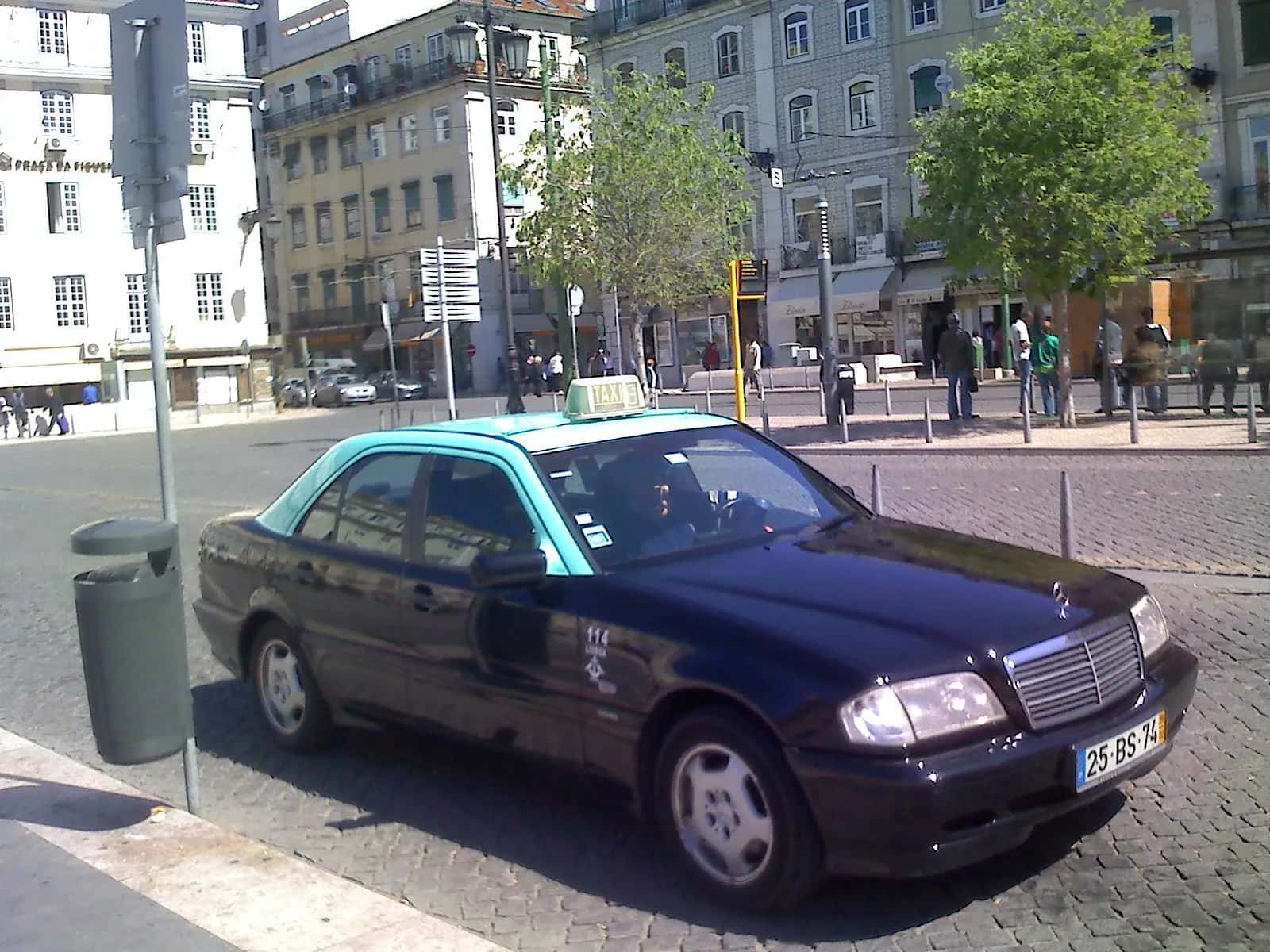
Lisbon's airport taxis are run by a regulated network of private operators and cooperatives, the largest of which are Cooptaxis and Geotaxi. All licensed taxis in the city — including those that serve the airport — are painted in a distinctive cream colour with a green roof, or in some older liveries, all black with a green roof. Both designs are legal and equally trustworthy; the colour is a regulatory choice that helps passengers identify a real taxi at a glance.
Taxis are available at Lisbon Airport every hour of every day. Even arrivals on overnight flights — typically transatlantic services from the Americas, or red-eye connections from northern Europe — find taxis waiting at the rank. There is no need to pre-book; the supply at LIS is reliable enough that walking up to the rank and taking the next available car is the standard approach for almost all travellers.
Unlike many large airports, Lisbon's airport taxi journey to the city centre is short. Humberto Delgado is one of the closest major airports to its city — about seven kilometres from Praça do Comércio in the historic Baixa district. In light traffic the trip can take fifteen minutes; during weekday rush hour it might stretch to thirty or thirty-five. This proximity is one of the reasons taxis remain attractive even with the rise of cheaper alternatives, since the absolute cost stays modest.
That said, Lisbon is not a city with a fixed airport flat fare. Drivers run the meter and charge whatever the trip works out to, plus permitted supplements for baggage, late-night travel, and pre-booked rides. This means two passengers heading to the same hotel may pay slightly different amounts depending on the route, the traffic, and the time of day. The system is generally fair, but it does require travellers to know what to look for.
Taxi Rank Locations at Terminal 1 and Terminal 2
Lisbon Airport has two terminals, and each has its own dedicated taxi rank. Knowing where to go saves time and prevents the common mistake of wandering toward unmarked vehicles solicited by drivers inside the building.
At Terminal 1, which handles the majority of international and full-service-airline arrivals, the taxi rank sits immediately outside the arrivals exit on the ground floor. Once you have collected your luggage and exited customs, follow the signs for "Taxis" — the queue is well-marked and patrolled by airport staff during busy periods. The rank is covered, which matters in summer when temperatures climb above thirty degrees, and it is connected to the terminal by a short, level walk that is friendly to wheeled luggage and accessible mobility devices.
At Terminal 2, used primarily by low-cost carriers including Ryanair, easyJet, and similar operators, the taxi rank is also adjacent to the arrivals area. Terminal 2 is smaller and feels less elaborate than T1, which sometimes catches travellers off guard, but the taxi infrastructure is identical. A clearly signposted rank, a queue manager during peak periods, and a steady supply of incoming taxis serve passengers as efficiently as the larger terminal.
For details on terminal layouts, gate locations, and inter-terminal transit, the dedicated main Lisbon Airport (LIS) overview covers each building in depth. The two terminals are connected by a free shuttle bus, but if you have a flight from one terminal and want to take a taxi from the other, just walk to the relevant rank — the shuttle is mainly for passengers transferring between flights.
One important practical note: do not accept rides from drivers who approach you inside the terminal building, in baggage claim, or in the public arrivals hall. These are sometimes unlicensed operators or drivers who park outside the official rank to skip the queue. They typically charge significantly more than metered taxis, and in rare cases passengers have reported route padding or destination disputes. Stick to the marked rank where vehicles arrive in order and a queue manager is usually present.
Fares — What to Expect to Pay
A typical metered taxi from Lisbon Airport to the city centre costs between fifteen and twenty-five euros, depending on the destination, traffic, and time of day. Specifically:
To the central neighbourhoods of Baixa, Chiado, Rossio, or Alfama, expect to pay in the range of fifteen to eighteen euros for an off-peak weekday ride. The journey is around seven kilometres and twenty minutes in normal traffic.
To Bairro Alto, Príncipe Real, or the riverside districts of Cais do Sodré and Belém, fares typically run from eighteen to twenty-three euros, reflecting the slightly longer distance and steeper climbs through the historic streets that can slow the meter at peak times.
To Parque das Nações, the modern eastern district near the Oceanário and the Vasco da Gama bridge, the journey is shorter — about four kilometres — and the fare often falls in the ten to fifteen euro range.
To outer suburbs like Cascais, Estoril, or Sintra, distances increase substantially and fares can range from forty to seventy euros depending on traffic and the specific destination. For these longer trips, weighing up the train alternative is often worthwhile — see our coverage of getting to Cascais from Lisbon Airport.
The Lisbon taxi tariff includes a base flag-down charge (around three euros and twenty-five cents during the day), a per-kilometre rate, and a slow-traffic surcharge calculated by time when the vehicle moves slowly or stops. Drivers are also entitled to charge for luggage placed in the trunk — typically one euro and sixty cents per piece, regardless of size — and a slightly higher tariff applies between 21:00 and 06:00, on weekends, and on public holidays.
If your fare seems substantially higher than these ranges, ask the driver politely to print a receipt (recibo) showing the breakdown. Honest drivers will provide it without hesitation, and the document is your basis for any complaint if something is wrong. For a broader cost comparison with other transport options, the dedicated guide on reaching central Lisbon from the airport compares all the alternatives side by side.
Official Lisbon Taxis — How to Recognise Them
Recognising a legitimate Lisbon taxi takes only a few seconds once you know what to look for. The standard livery is cream-coloured body with a green roof; older vehicles still in service may be entirely black with a green roof. Both colour schemes are official. The illuminated "Taxi" sign on the roof is universal, and a meter (taxímetro) on the dashboard is required by law. Each vehicle carries a unique licence number visible on the bodywork and inside the cabin.
The two largest cooperatives that supply most airport taxis are Cooptaxis and Geotaxi. Both are reliable, with vehicles generally in good condition and drivers who have at least basic English in addition to Portuguese. Other smaller cooperatives operate as well, but they meet the same regulatory standards. The cooperative does not affect fare or quality of service in any meaningful way for the passenger.
Drivers carry a visible identification card showing their photograph, name, and licence number. This is required by Portuguese regulations and is worth glancing at before you start a long journey, both as a courtesy and so you have details to reference if anything goes wrong. Most drivers also display a small printed list of standard tariffs and supplements, which gives you something to point to if a fare dispute arises.
Inside the vehicle, the meter must be visible from the passenger seat and clearly switched on at the start of the trip. If the meter is off when the journey begins, ask the driver to switch it on. If the response is "the meter is broken" or "I can give you a flat rate," politely decline, exit the vehicle, and take the next taxi in the queue. This is one of the most common signals that something is off, and the airport staff at the rank will usually intervene if you need help.
Ride-Hailing Alternatives — Uber, Bolt, and Free Now
Ride-hailing has grown rapidly in Lisbon since the mid-2010s and now competes seriously with traditional taxis on the airport route. The three major platforms are Uber, Bolt, and Free Now (the rebranded mytaxi service that aggregates licensed taxis). All three operate legally and reliably at Lisbon Airport.
For most travellers heading to the central neighbourhoods, ride-hailing apps are cheaper than metered taxis, sometimes by thirty or forty percent. A typical Uber or Bolt ride to Baixa runs around ten to fourteen euros at off-peak times, against the fifteen-plus euros a taxi would charge. The savings are even more pronounced for short trips to Parque das Nações, where an Uber might cost six or seven euros.
The pickup point for ride-hailing differs slightly from the taxi rank. At Terminal 1, ride-hailing pickups have historically been directed to the Departures level (one floor above arrivals) rather than the arrivals taxi rank — partly to manage curb congestion and partly to keep ride-hailing physically separated from the licensed taxi queue. Check your app for the exact pickup location, which is usually pinned with terminal-level precision.
One trade-off: ride-hailing pricing is dynamic. During peak demand — late afternoons, Friday evenings, large flight arrival waves — surge pricing can briefly push fares above what a regular taxi would charge. If you see a quoted fare that seems unreasonably high, wait fifteen or twenty minutes and check again, or simply walk to the taxi rank for a metered ride.
Bolt is generally regarded as the cheapest of the three platforms in Lisbon and is widely used by locals; Uber tends to have slightly more drivers available at any given moment; Free Now connects you to licensed Lisbon taxis at metered rates plus a small platform fee, which is useful if you specifically want a regulated taxi without queuing at the rank. For a fuller picture of the comparison, see our coverage of all airport transfer options.
What are the payment options?
The vast majority of Lisbon taxis now accept card payments alongside cash, including contactless via Visa, Mastercard, and Apple Pay or Google Pay on smartphones. This is a relatively recent shift — historically taxis were cash-only — and a small minority of older vehicles or older drivers still prefer or only accept cash. To avoid surprises, it is worth confirming when you get in: a simple "Posso pagar com cartão?" ("Can I pay by card?") usually clarifies things in seconds.
If you are paying by card, you will typically tap or insert your card into a small reader at the end of the journey. The driver will print a receipt automatically; if not, ask for one ("recibo, por favor"). For card payments the receipt is your record of the transaction and is useful for expense reports or any later complaint.
For cash, euros are required — Lisbon taxis do not accept other currencies. If you have just arrived and have no cash, the airport ATMs (ATMs are called "Multibanco" or sometimes "MB" in Portuguese) are located in the arrivals areas of both terminals, and dispense euros at standard interbank rates with whatever fees your home bank charges for foreign withdrawals. Avoid the foreign exchange counters in the airport for this purpose; they offer worse rates than the ATMs.
Ride-hailing apps such as Uber and Bolt charge your registered payment method automatically — there is no need to handle cash or cards in the vehicle. This is one of the practical reasons ride-hailing has become popular for travellers landing late at night or those who simply prefer not to manage transactions in an unfamiliar currency.
Tipping in Portugal
Tipping in Portugal is generally modest and not socially required, including for taxi drivers. The accepted convention is to round up to the nearest euro on smaller fares or add a small amount — typically one or two euros on a fifteen-to-twenty-euro ride — if the driver was helpful, friendly, or assisted with luggage. There is no expectation of a percentage-based tip the way there is in some North American cultures.
For longer rides — say, the trip to Cascais or Sintra — a tip of two to five euros is generous and appreciated. If a driver helps you load and unload heavy luggage, navigates challenging traffic gracefully, or offers useful local advice, recognising that with a small additional payment is courteous.
Conversely, if the service was poor — the driver was rude, drove dangerously, or padded the route — there is no obligation to tip at all, and many locals would not. Portuguese culture is generally relaxed about tipping, and drivers do not depend on tips for their income the way some service workers in other countries do.
One specific note: when paying by card, the card reader may prompt you to add a tip on top of the fare. This is a relatively new feature in Portugal and it is entirely optional. Selecting "no tip" is socially acceptable and will not cause offence. The expectation is the modest rounded-up cash amount described above, not the more aggressive tip prompts familiar from US payment systems.
Late-Night Taxis and Night Surcharges
Lisbon taxis operate twenty-four hours, including from the airport, but a night tariff (Tarifa 2) applies between 21:00 and 06:00, on weekends, and on public holidays. The night tariff increases the per-kilometre rate and the slow-traffic time-charge by approximately twenty percent. The base flag-down fee is also slightly higher.
In practical terms, a fifteen-euro daytime ride to Baixa might cost seventeen or eighteen euros at night. The increase is modest but real, and it is worth knowing about when you are budgeting for an overnight or red-eye arrival. Drivers should automatically switch the meter to the correct tariff based on the time; if you suspect the wrong tariff has been applied, you can ask to see the meter setting and reference the printed tariff card displayed in most cabs.
For arrivals between roughly midnight and five in the morning, taxis remain the most practical option for most travellers. The Metro stops running shortly after one in the morning and resumes around 06:30, and Carris bus 783 has limited overnight service. A taxi to a central hotel during these hours typically costs between eighteen and twenty-five euros and is worth the convenience of a direct ride to your accommodation rather than a multi-stage journey on the limited night bus network.
The supply of taxis at the airport rank during the late-night hours is generally adequate for incoming flights, since drivers know the schedule of overnight arrivals and position themselves accordingly. On unusually busy nights — major holidays, a cluster of delayed transatlantic flights all arriving at once — there can be brief queues at the rank, but rarely longer than fifteen or twenty minutes.
Accessibility — Taxis for Wheelchair and Reduced-Mobility Passengers
Lisbon's taxi fleet includes a number of wheelchair-accessible vehicles that can accommodate passengers in standard manual or electric wheelchairs without requiring transfer to a regular seat. These are typically larger vans with rear ramps and floor clamps to secure the chair during transit. Cooptaxis operates a particularly good fleet of such vehicles, and they can be requested specifically.
For arrivals at Lisbon Airport, the most reliable way to secure an accessible taxi is to book in advance rather than rely on the rank. Cooptaxis and Geotaxi both accept bookings by phone, and several mobility-focused services such as Mobility Travel Portugal specialise in airport pickups for travellers with reduced mobility. Pre-booking by twenty-four hours is the safer approach; same-day requests work but availability is less certain.
If you arrive without a pre-booking and need an accessible vehicle, ask the staff at the official taxi rank — there is usually an attendant during business hours who can radio for an appropriate vehicle. The wait may be twenty to forty minutes, but the service exists and is reasonably reliable.
Standard taxis generally accommodate folding wheelchairs, walkers, and other mobility aids that fit in the trunk, and most drivers will assist with loading and unloading. The cost of accessible service is the same as any standard metered ride — there is no surcharge for the accommodation itself, though the per-piece luggage fee applies as for any traveller.
Common Scams and How to Avoid Them
Most Lisbon taxi journeys are honest, but a small minority of drivers — both at the airport and in the city centre — engage in practices that overcharge unsuspecting tourists. Knowing the patterns helps you spot and avoid them.
The most common issue is route padding — taking a longer route than necessary to inflate the metered fare. This is hardest to detect for a first-time visitor who does not know the city. The defence is straightforward: open Google Maps or Apple Maps on your phone before getting in the cab, set your destination, and watch the route. If the driver deviates substantially without explanation, ask why. Honest drivers may have a legitimate reason (traffic, road closures); dishonest ones tend to backtrack or accelerate when challenged.
The second pattern is the "meter is broken" claim, where a driver offers a flat rate instead of running the meter. The flat rate is almost always higher than the metered fare would have been. The correct response is to politely decline and take the next taxi in the queue. At the airport rank, the queue manager will help you switch vehicles without drama.
A third issue is incorrect tariff application — running the night tariff (Tarifa 2) during daytime hours, or claiming a luggage fee that exceeds the regulated rate. The defence is to ask for the printed receipt at the end of the journey and review the tariff codes. Tarifa 1 should appear for daytime weekday rides; Tarifa 2 for nights, weekends, and holidays. If the wrong code was used, you can dispute the charge.
The fourth — and rarest — issue is unlicensed vehicles soliciting passengers inside the terminal or in the car park. These are not real taxis. They are unregulated, uninsured for passenger transport, and have charged tourists three or four times the going rate in some reported cases. Always use the marked rank or a recognised ride-hailing app. If a driver approaches you inside the terminal offering a ride, decline and walk away.
What to Do if You Are Overcharged or Mistreated?
If you feel a taxi has overcharged you or behaved improperly, the first step is to request the receipt ("recibo, por favor"). This is your legal right and the receipt should show the driver's licence number, the cab licence number, the start and end of the trip, the tariff code applied, and the total fare. Most disputes can be resolved at this point — drivers are aware that paperwork creates accountability.
If the issue is not resolved with the driver, note the cab licence number and the driver identification details. For complaints, the Portuguese authority responsible for transport, IMT (Instituto da Mobilidade e dos Transportes), accepts complaints by email and through the Livro de Reclamações system available in physical and electronic form. The airport itself, through the operator ANA Aeroportos de Portugal, also accepts complaints related to taxi service at its terminals and can sanction drivers operating from its ranks.
For card payments, your bank or card issuer is another route to dispute charges if you believe you were defrauded. Provide them with the receipt and a description of the issue. Card chargebacks are generally available where the service was misrepresented or substantially different from what was agreed.
For the airport rank specifically, the queue attendant is often able to defuse situations on the spot. They know the regular drivers, can identify outliers, and have a vested interest in keeping the rank running smoothly. If something feels wrong — the meter behaviour, the route, the fare — flagging it before you leave the airport area is usually faster and more effective than later formal complaints.
Most importantly, if you feel unsafe at any point, end the ride, exit the vehicle in a populated area, and call 112 (the Portuguese emergency number, which connects to police, ambulance, and fire services and is staffed by multilingual operators). Such situations are rare with Lisbon airport taxis, but knowing the option exists is reassuring.
Sample Fares to Popular Areas
Approximate fares from Lisbon Airport (LIS) to commonly requested destinations, all assuming daytime weekday traffic and Tarifa 1:
Baixa-Chiado / Rossio / Praça do Comércio: €15–18, ~20 minutes. The historic core of the city; most central hotels are within a short walk of these landmarks.
Bairro Alto / Príncipe Real: €17–22, ~25 minutes. Slightly steeper climb through narrow streets that slow the meter.
Cais do Sodré: €15–19, ~20 minutes. Riverside area with excellent transport connections to the Cascais line.
Belém: €18–24, ~25 minutes. The monument district, home to Jerónimos Monastery and Belém Tower; the longer distance reflects the riverside drive west.
Alfama: €15–18, ~20 minutes. The historic Moorish quarter; many streets are too narrow for taxis to enter, so expect to be dropped at a square nearby and walk the last few minutes.
Parque das Nações / Oriente: €10–15, ~15 minutes. The closest major destination to LIS — modern, business-oriented, near the river and the Vasco da Gama tower.
Saldanha / Avenidas Novas: €13–17, ~15 minutes. Business district with many upper-tier hotels.
Marquês de Pombal / Avenida da Liberdade: €14–18, ~20 minutes. Upmarket shopping and hotel district.
Estrela / Lapa: €18–22, ~25 minutes. Quieter, leafy embassy and residential district.
Beyond the city itself, longer journeys to Cascais (€55–70), Sintra (€55–75), Estoril (€50–65), and Mafra (€60–80) are available. For these distances, advance planning — and weighing the train alternative — is recommended.
When to Take a Taxi vs. Public Transport or a Private Transfer?
Taxis are not always the best choice from Lisbon Airport, and being honest about the trade-offs helps you choose well. Here is when each option makes the most sense.
Take a taxi (or ride-hailing) when: you are arriving with substantial luggage that would be cumbersome on the Metro stairs and escalators; you are travelling in a group of three or four people splitting the cost; you are arriving late at night when public transport is reduced; your destination is more than fifteen minutes' walk from a Metro station; or the small premium over public transport is worth the door-to-door convenience to you.
Take the Metro when: you are travelling solo or as a couple with manageable luggage; your destination is in the central neighbourhoods well-served by the Metro network; you have plenty of time and want to save five or ten euros; or the Metro Red Line conveniently terminates at the airport (Aeroporto station, T1 only) — see our dedicated Lisbon Airport Metro guide for details.
Take Carris bus 783 when: you want a direct, supervised ride into the city with luggage space, no transfers, and a flat rate of around five euros; or you are heading specifically to the line route which serves Cais do Sodré with stops in central districts.
Pre-book a private transfer when: you are travelling with children who need car seats; you are arriving on a late flight and want certainty rather than hoping for available rides; you are part of a larger group needing a van; or the convenience of a meet-and-greet at arrivals justifies the higher cost.
For a side-by-side comparison of all options including costs and times, see how to get to Lisbon city centre from the airport and the broader airport transfers overview.
Booking Taxis in Advance vs. Using the Rank
For arrivals at Lisbon Airport, walking to the rank is almost always sufficient — the supply of taxis is reliable, the queues move quickly, and the metered fare is the same whether you book ahead or simply walk up. There are, however, situations where pre-booking makes sense.
Pre-book if: you require an accessible vehicle for wheelchair access; you have an unusually large group needing a minivan; you are travelling with infant or child car seats not commonly carried in standard cabs; you want a fixed quote rather than a meter (some taxi cooperatives offer this for airport-to-city pre-booked rides); or you simply prefer the certainty of knowing a vehicle is waiting with your name on it.
Pre-booking for a Lisbon airport pickup typically involves contacting Cooptaxis or Geotaxi by phone or via their websites, providing your flight details, and confirming a pickup time. The driver tracks your flight and adjusts pickup time for delays, and meets you in the arrivals area holding a sign with your name. The fare is generally the metered rate or a small fixed premium for the service.
For ride-hailing — Uber, Bolt, Free Now — the equivalent of pre-booking is simply opening the app on arrival. There is no need to schedule in advance for most trips since drivers respond within minutes. The exception is for very early morning departures from your hotel back to the airport, where you can schedule a ride a day in advance and the platform will dispatch a driver to your pickup point at the requested time.
For travellers who specifically want a fixed flat fare to the airport from their hotel for the return trip, some cooperatives offer flat-rate "airport package" pricing — typically €20–25 to most central hotels, with luggage included. Whether this is cheaper than the metered fare depends on traffic that day; during heavy congestion it can save money.
Practical Tips for a Smooth Taxi Experience
Several small habits make airport taxi journeys substantially easier. None of them require fluent Portuguese or extensive local knowledge.
Have your destination ready in writing. Show the driver your hotel address on your phone or a printed booking confirmation. This eliminates miscommunication and ensures you arrive where you intended even if the driver's English is limited and your Portuguese is non-existent.
Note the route on your phone. Pull up Google Maps or Apple Maps with your destination set before you get in the cab. Keep an eye on the route during the trip — not as a paranoid surveillance, but as a sanity check. Most drivers take reasonable routes; the small minority who don't are easier to identify when you have a reference.
Confirm payment method up front. If you intend to pay by card, ask "Cartão?" before the meter starts. Most accept it, but the rare cash-only driver should be flagged early so you can switch cabs if needed rather than discover the issue at the destination.
Keep small change for cash payments. Drivers prefer not to break large notes for short fares. A €20 or €50 from a recent ATM withdrawal is harder to handle than a few €5s and €10s. If you must pay with a large note, mention it before the trip starts so the driver can prepare change.
Note the licence number when you get in. A casual glance at the licence number (visible inside the cabin) takes a second and provides a record if you need it later. You will rarely need it, but knowing it is there reduces your reliance on goodwill.
Be patient at peak times. The taxi rank can have a short queue during cluster arrival periods (often mid-morning when many transatlantic flights land, or early evening when European traffic peaks). The wait is usually ten to twenty minutes maximum and reflects healthy supply rather than dysfunction.
Trust the queue. If a driver approaches you inside the terminal or solicits a ride away from the rank, walk past. The few minutes of waiting at the official rank are worth the protection that the regulated system provides.
Returning to the Airport — Taxis from the City
The taxi journey in the opposite direction — from your accommodation to Lisbon Airport — works the same way and at similar fares. Most central hotels can call a taxi for guests on request, and the wait at the door is typically five to ten minutes during normal hours.
For a return-to-airport ride, leave more time than the journey itself takes. Lisbon traffic varies considerably by time of day, and on weekday mornings and Friday evenings the trip from the centre to the airport can stretch from twenty minutes to forty-five depending on conditions. Plan for a ninety-minute buffer for international flights, including check-in and security.
Several alternatives compete with hotel-called taxis for the return trip: ride-hailing apps work just as well in the opposite direction; Carris bus 783 runs frequently during the day; and the Metro Red Line connects most central districts to the Aeroporto terminus station with a single Yellow- or Green-line transfer. For a fuller comparison see our general Lisbon taxis guide covering city-wide service.
If you have an early-morning flight (departures before 06:30), the Metro will not be running and a pre-booked taxi or ride-hailing app is the most reliable option. Schedule the ride the night before either through your hotel concierge or directly via Uber/Bolt's "schedule a ride" feature. This avoids the small risk of drivers being scarce in the very early hours.
For passengers staying near the airport — at hotels in Olivais, Encarnação, or Parque das Nações — taxis are quick and inexpensive (typically €8–12) and don't require advance booking. The proximity makes these areas attractive for travellers with very early flights or those preferring to spend their last night close to the terminal.
Summary — Choosing and Using Lisbon Airport Taxis Confidently
Lisbon Airport taxis are reliable, reasonably priced, and easy to use once you know the basics. The cream-and-green livery, the official ranks at Terminal 1 and Terminal 2, the metered fares typically in the €15–25 range to the city centre, and the option to pay by card all combine to make airport taxis a workable option for almost any traveller. The key cautions — avoid drivers who solicit inside the terminal, watch the route on your phone, ask for receipts on every fare, and be aware of the night tariff after 21:00 — are simple precautions that take the small risks out of the equation.
For travellers who prefer to save money or use a familiar interface, ride-hailing apps (Uber, Bolt, Free Now) are competitive and often cheaper, though pickup locations differ slightly from the taxi rank and surge pricing can occasionally erode the savings. For travellers who want maximum certainty — accessible vehicles, large groups, very early flights — pre-booking is the right choice and is straightforward through the major cooperatives.
The taxi system at Lisbon Airport reflects the broader Portuguese approach to service: practical, generally honest, modestly priced, and unobtrusive. Most journeys go well, and the small set of cautions described in this guide cover the rare situations where things might not. With this background you should feel confident walking to the rank on arrival, trusting the meter, and beginning your time in Lisbon with a smooth, uneventful ride into the city.
For broader context on getting to and from the airport, see our overarching guide to Lisbon Airport transfers, which compares all the transport options side by side.
Want a stress-free taxi experience? Reach out
You May Also Like
- Lisbon Airport (LIS) — Main Overview
- Lisbon Taxis — Citywide Guide
- Lisbon Airport Transfers — All Options
- How to Get from Lisbon Airport to the City Centre
Update (2023): The Aerobus shuttle service (formerly aerobus.pt) was discontinued. Carris urban bus lines 783, 728, 744 and 24-hour night line 208 now provide all public airport–city connections at €2.30 per ride.
Heading to Sintra from Lisbon Airport? Compare all options: 5 transport options from LIS to Sintra — Metro+train, taxi, Scotturb 403 via Cascais, more.