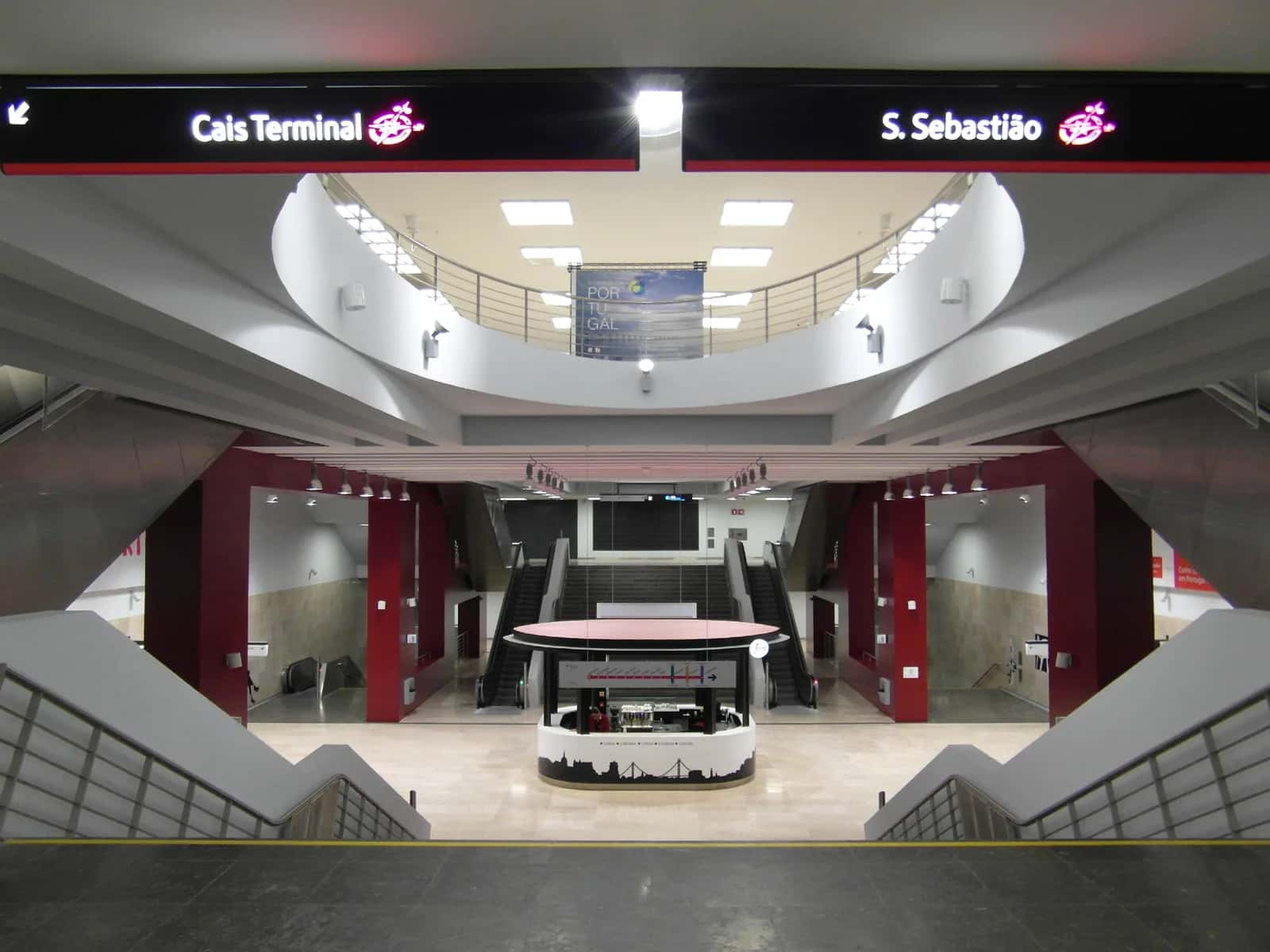
Lisbon Airport Metro — Red Line (Linha Vermelha)
| Detail | Value |
|---|---|
| Line | Red Line (Linha Vermelha) |
| Direction | Airport (Aeroporto) → São Sebastião |
| Price | €1.90 single + €0.50 Viva Viagem card (one-time) |
| Day pass | €7.25 (unlimited metro/bus/tram for 24h) |
| Service hours | 06:30 – 01:00 |
| Frequency | Every 5–8 min peak, 10 min off-peak |
| Duration to Oriente | ~5 min |
| Duration to city center (Baixa-Chiado) | ~25 min (with 1 transfer) |
Cheapest route from LIS to city. Buy Viva Viagem card from ticket machines — works on metro, bus, tram, and CP trains.
Lisbon Airport Metro: The Complete Guide to the Red Line and Reaching the City
The Lisbon Metro Red Line (Linha Vermelha) is the fastest, cheapest, and most reliable way to get from Humberto Delgado Airport into central Lisbon and the wider metropolitan rail network. The terminus station "Aeroporto" sits directly underneath Terminal 1 of the airport, and trains depart roughly every six to nine minutes for most of the day, carrying passengers into the city for less than the price of a coffee. For the vast majority of arriving travellers — solo visitors, couples, families with reasonably manageable luggage — the Metro is the option that simply makes sense, both financially and logistically.
That said, the Lisbon Metro can be confusing on a first visit. The system uses both single tickets and a rechargeable Viva Viagem card, the airport station is only at Terminal 1 (so Terminal 2 passengers need a free shuttle bus first), and the Red Line itself does not directly serve the most famous tourist neighbourhoods of Baixa, Chiado, or Alfama. Understanding how to reach those areas — and which transfer station to use — turns a potentially stressful first hour in Lisbon into a smooth one. This guide covers the practical knowledge you need: ticket prices, transfer points, journey times, accessibility, late-night options, and the common mistakes that catch out first-time visitors.
The Red Line: How the Lisbon Airport Metro Connects to the City
The Linha Vermelha (Red Line) is one of four lines on the Lisbon Metro network. It runs from Aeroporto in the northeast — directly underneath Terminal 1 — toward the southwest, terminating at São Sebastião where it intersects with the Blue Line (Linha Azul). Along the way, it passes through several major interchange stations that connect to the rest of the city's rail network, including the Yellow Line (Linha Amarela) at Saldanha, and the Green Line (Linha Verde) via a transfer at Alameda.
For most travellers heading to a hotel in central Lisbon, the journey involves taking the Red Line from Aeroporto and changing trains at one of these interchange stations. The full journey from the airport to a typical city-centre destination such as Rossio, Baixa-Chiado, or Cais do Sodré takes between twenty and thirty-five minutes including transfer time, and costs the price of a single ticket plus the small reusable card fee. There is no need to buy multiple tickets for transfers within the metro system — a single fare covers your entire journey within the network.
The first station after Aeroporto is Encarnação, a residential stop that few tourists use. The next is Moscavide, then Oriente — a major transport hub that connects to the suburban rail network (CP) and the long-distance bus terminal, useful for travellers heading on to Sintra, Cascais, or other Portuguese cities. After Oriente the line continues through Cabo Ruivo, Olaias, and Alameda, before reaching the central interchange stations: Areeiro, Roma, Alvalade, Campo Grande, Cidade Universitária, Entre Campos, Campo Pequeno, Saldanha, and São Sebastião. Each of these has its own purpose for travellers with different destinations, which we will cover in detail further down.
Where to Find the Aeroporto Metro Station?
The Aeroporto station is located beneath Terminal 1 of Lisbon Airport. From the arrivals hall of T1, signs to the Metro are clearly marked in Portuguese ("Metro") and English. Follow them through the terminal — the entrance is on the ground floor, near the main exit toward the bus stops and taxi rank. Escalators and a lift take you down to the ticket hall, where you will find ticket vending machines and turnstiles giving access to the platforms.
The station is fully integrated with the airport, meaning you can walk from the baggage carousel to the metro platform in roughly five to ten minutes, depending on which gate you arrived at and how busy the terminal is. There is no exposure to the weather and no need to navigate complicated outdoor walkways. For travellers with reasonable luggage and reasonable mobility, the walk is straightforward.
Crucially, the Metro station serves Terminal 1 only. Passengers arriving at Terminal 2 — which serves low-cost carriers including some easyJet and Ryanair flights — need to take the free inter-terminal shuttle bus first to reach T1, then walk to the Metro entrance from there. The shuttle runs every twelve to fifteen minutes during the day and the journey takes about seven to ten minutes. Allow extra time if you are starting from T2.
If you are at all uncertain which terminal you are arriving at, check your boarding pass or your airline's confirmation. The terminal designation is printed on the boarding pass, and the airline app usually displays it as well. Knowing in advance saves frustration on arrival, particularly when you are tired from a long flight.
Tickets, Cards, and Pricing
The Lisbon Metro uses a contactless smart card system called Viva Viagem (sometimes called the 7 Colinas card). The physical card costs €0.50 and is reusable for one year — you can keep it for return trips, recharge it as needed, and use it on Metro, buses (Carris), trams, the Santa Justa lift, the city ferries, and the suburban CP train network. For visitors arriving at the airport, buying a Viva Viagem card and loading a single fare onto it is the standard approach.
The single Metro fare is €1.90 (in addition to the €0.50 card fee on first purchase). This single ticket is valid for one Metro journey, including any transfers between Metro lines, and is good for sixty minutes from validation. If you only plan to use the Metro twice during your stay, two single fares loaded onto a single card cost €3.70 plus the €0.50 card fee.
For travellers planning to use public transport more extensively, the 24-hour pass on the Viva Viagem card costs €7.25 and gives unlimited access to Metro, buses, trams, ferries, and elevators within the city zone. This is excellent value for anyone planning to combine Metro travel with the famous Lisbon tram lines (28, 12, 15) or to take buses between neighbourhoods. The 24-hour clock starts from the first validation.
Alternatively, you can use the "Zapping" balance feature on the Viva Viagem card, which lets you load any amount of money onto the card and have fares deducted as you travel. The Zapping rate per Metro journey is slightly cheaper than the standalone single fare (€1.72 instead of €1.90), and it gives flexibility — useful if you are not sure how many trips you will take.
Children under four travel free on the Lisbon Metro. Children between four and twelve pay reduced fares, and seniors over sixty-five qualify for discounts on multi-day passes. Keep your card and ticket receipt with you throughout your journey — random ticket inspections do occur, and travelling without a valid fare incurs a substantial fine.
How to Buy Your Ticket at the Airport?
The Aeroporto Metro station has multiple ticket vending machines in the ticket hall, all of which support English, Portuguese, Spanish, French, German, and several other languages. The machines accept coins, banknotes (smaller denominations only — avoid trying €50 notes), and contactless credit and debit cards including Apple Pay and Google Pay.
The interface is straightforward. Select your language. Choose between buying a new Viva Viagem card or recharging an existing one. If buying new, choose your fare type (single, 24-hour, Zapping). Pay. The card is dispensed along with a receipt. Validate the card by tapping it on the turnstile reader as you enter the platform area — a green light and brief tone confirm that you are through.
The whole process takes about two to four minutes once you reach the machines. There can be small queues during peak arrival times in summer, but the machines move fairly quickly and there are usually several available simultaneously. If you have a problem with a machine, staff are typically available at a small information desk in the station, and they can help in English.
Remember to keep your Viva Viagem card after you exit at your destination — there are no exit gates that consume the ticket, but you may need it for inspections, and it is reusable. Many travellers store it in a wallet or phone case for the duration of their stay, recharging at any Metro or train station as needed.
Major Transfers: Reaching Central Lisbon Neighbourhoods
The Red Line itself does not pass through the historic city centre. To reach the famous tourist neighbourhoods, you will need to transfer at one of three key stations. Choosing the right transfer point is the most important navigation decision for first-time visitors.
Transfer at São Sebastião — the western terminus of the Red Line — gives access to the Blue Line (Linha Azul). The Blue Line runs through Marquês de Pombal (a major business and shopping area), Avenida (the upscale shopping district along Avenida da Liberdade), and continues to Restauradores, Rossio, Baixa-Chiado, and Terreiro do Paço. If your hotel is in Baixa, Chiado, the historic centre, or anywhere along Avenida da Liberdade, this is your transfer.
Transfer at Alameda connects the Red Line to the Green Line (Linha Verde). The Green Line runs to Martim Moniz (gateway to Mouraria and Alfama), Rossio, and Baixa-Chiado as well, plus heading north to Telheiras. For travellers heading to Alfama, the Castle of São Jorge area, or the Mouraria neighbourhood, Alameda is often the most efficient transfer.
Transfer at Saldanha connects to the Yellow Line (Linha Amarela), which runs through Picoas, Marquês de Pombal, Rato, and on toward Campo Grande. Less directly useful for tourists, but convenient for business travellers heading to hotels in the upper city or near Marquês de Pombal.
For travellers heading to Belém — the famous tower, monastery, and Pastéis de Belém district — there is no direct Metro connection. The best route is to take the Metro to Cais do Sodré (transfer at Baixa-Chiado from Blue Line, or from the Green Line) and then catch the Cascais commuter train (CP), or take tram 15 from Praça da Figueira. Plan around forty-five minutes to an hour from the airport to Belém in total.
Connection to the Suburban Rail Network at Oriente
For travellers heading beyond Lisbon — to Cascais, Sintra, the Algarve, Porto, or other Portuguese cities — the Oriente station, three stops south of the airport on the Red Line, is a critical transfer point. Oriente is one of Portugal's largest transport hubs, designed by Santiago Calatrava for the Expo '98 world fair, and it integrates Metro, suburban trains (CP — Comboios de Portugal), the long-distance bus terminal (Sete Rios's main competitor), and the high-speed Alfa Pendular trains.
From Oriente, suburban trains run frequently to Sintra (the UNESCO-listed palace town), Cascais (the seaside resort), and other regional destinations. Long-distance trains to Porto, Coimbra, Faro, and the Algarve also depart from here. If you are travelling onward by rail rather than staying in Lisbon proper, the standard route is: arrive at the airport, take the Metro Red Line three stops south to Oriente, transfer to your CP train.
The transfer at Oriente is well-signed but the station is large — allow ten to fifteen minutes between trains for a comfortable connection. There is also a small commercial area with cafes, restaurants, and shops if you have a wait between connections. Connecting from the airport to the train station is one of the most common journey types for travellers who use Lisbon as a gateway to wider Portugal.
Accessibility on the Lisbon Metro
The Lisbon Metro has made significant strides in accessibility over the past two decades, though older stations still present challenges. Aeroporto station, being relatively new (it opened in 2012), is fully accessible with lifts between street level, ticket hall, and platforms. Wheelchair users, travellers with reduced mobility, and parents with prams can navigate the airport station without using stairs or escalators.
However, the broader Metro network is uneven. Some older stations have only escalators or stairs between platforms and street level, with no lift access. If accessibility is essential to your journey, it is worth checking Metropolitano de Lisboa's official station-by-station accessibility map before travelling. Stations that are fully accessible (with lifts to every level) include Aeroporto, Oriente, Alvalade, Saldanha, Marquês de Pombal, and most of the newer stations on the Blue, Yellow, and Red lines.
For travellers with reduced mobility who need to reach a station without lift access, alternative options include taxi, ride-share (Uber, Bolt, FreeNow), or pre-arranged accessible transfers. Many Lisbon hotels are within reasonable walking distance of an accessible Metro station, so route planning matters as much as the Metro accessibility itself.
Service animals are welcome throughout the Metro network. Larger pets must travel in carriers and may not be permitted at peak times. Children's pushchairs and prams are allowed without restriction.
Luggage on the Metro: What to Expect
The Lisbon Metro is suitable for travellers with normal luggage — a carry-on plus a checked bag, or a similar combination. The trains are reasonably spacious, the platforms are wide, and the airport station has lifts to handle wheeled suitcases. Most travellers find that they can manage their luggage on the Metro without significant difficulty.
That said, there are practical considerations. During peak commuting hours (roughly 07:30–09:30 in the morning and 17:30–19:30 in the evening on weekdays), trains can become crowded, and manoeuvring large suitcases through dense crowds is harder. If you arrive during these times and have multiple bulky bags, you may prefer a taxi or transfer service for comfort.
If you have several large suitcases, sports equipment, oversized boxes, or other unusual luggage, the Metro becomes less practical. In these cases, a taxi or private transfer with a vehicle sized for your needs is the better option. Taxis and ride-share vehicles can typically accommodate two large suitcases plus carry-ons; for groups of four or more with substantial luggage, a larger transfer van or a pre-booked private service is usually most efficient.
Once on the train, place your luggage in the dedicated luggage areas near the doors of each carriage, or stand near it where you can keep an eye on it. Theft is rare on the Lisbon Metro but ordinary common-sense precautions apply, particularly during crowded times.
Journey Time and Frequency
The Red Line operates with high frequency throughout the day. Trains run every six to seven minutes during peak hours and every eight to nine minutes during off-peak times. Late evening service, after about 22:00, runs every nine to twelve minutes. There is no waiting for long periods on the Red Line during normal operating hours — your worst-case wait at the platform is rarely more than ten minutes.
From Aeroporto to typical destinations, plan the following approximate times (including transfer where applicable): Oriente — 6 minutes direct. Alameda — 14 minutes direct (transfer to Green Line for Baixa-Chiado, Rossio). São Sebastião — 18 minutes direct (transfer to Blue Line for central neighbourhoods). Marquês de Pombal — 22 minutes including transfer at São Sebastião. Avenida — 24 minutes including transfer. Restauradores — 26 minutes including transfer. Rossio (Green Line) — 22 minutes including transfer at Alameda. Baixa-Chiado — 25–28 minutes including transfer.
For comparison, a taxi or ride-share from the airport to central Lisbon takes roughly twenty to forty minutes depending on traffic and time of day. The Metro can be faster than a taxi during peak traffic hours, when central Lisbon's narrow streets become congested. Choosing between Metro, taxi, Carris airport bus, and other options depends on your specific destination, time of arrival, and luggage.
Operating Hours and Late-Night Service
The Lisbon Metro Red Line operates from 06:30 to 01:00 every day. The first train from Aeroporto departs at approximately 06:35 in the morning, and the last train leaves at around 01:00. These times are consistent year-round, with rare adjustments during major holidays or special events.
For travellers arriving on flights that land outside Metro operating hours — late-night arrivals after 01:00 or very early morning arrivals before 06:30 — the Metro is not an option. Alternatives include the 24-hour Carris 208 night-bus service that connects the airport to central Lisbon, taxis (always available at the airport rank), or pre-booked private transfers. Shuttle bus options include both Carris bus 783 and various hotel courtesy shuttles.
Sunday service is identical to weekday service in terms of frequency — there is no reduction for weekends or holidays, which is a welcome contrast to some other European cities. Major public holidays (Christmas Day, New Year's Day, Easter Sunday) follow Sunday timetables but otherwise operate normally.
Note that Carris bus 783 runs more frequently late at night, including the small overnight gap between Metro service hours, making it the preferred option for travellers arriving at unusual times. Carris bus 783 from the airport runs to Cais do Sodré with stops at major hotels and city-centre points, and is useful when the Metro is not running.
Tickets and Validation: Common Confusion Points
One persistent source of confusion for first-time visitors is the requirement to validate the Viva Viagem card on every Metro entry. The validation involves tapping the card on the green sensor pad on the turnstile gate as you walk through. The gate opens, you walk through, and the system records your entry. There is no equivalent validation on exit — Lisbon Metro uses a "validate on entry only" system within the network.
However, transfers between lines do not require re-validation. Once you have validated at the entry gate, you remain in the paid zone of the Metro network until you exit through another gate. You can ride the Red Line to São Sebastião, walk to the Blue Line platform, board a Blue Line train, ride to Restauradores, and exit — all on a single validation.
The single ticket has a sixty-minute time limit, but this is rarely a constraint for typical Metro journeys, which take well under an hour even with transfers. The 24-hour pass eliminates this concern entirely if you plan multiple trips during the day.
One mistake that catches out first-time visitors: trying to use a paper ticket from a bus or tram on the Metro. Different transport modes within the Lisbon network share the Viva Viagem card system, but specific paper tickets are mode-specific. The Viva Viagem card is the cross-mode currency. If you bought a single bus ticket from the driver, that ticket only works on that bus.
Safety and Common Sense
The Lisbon Metro is generally a safe public transport system. Stations are well-lit, monitored by staff and CCTV, and patrolled by transit security. Late-night travel is fine for solo passengers, though many travellers arriving late naturally prefer the convenience of a taxi or transfer.
Standard urban precautions apply. Keep your wallet, phone, and other valuables in inside pockets or zipped bags rather than easily accessible outer pockets. Be aware of your surroundings, particularly in crowded conditions where pickpockets occasionally operate. Pickpocketing in Lisbon is generally less prevalent than in Barcelona, Rome, or Paris, but it is not unknown, particularly on routes frequented by tourists.
Lost or stolen items can be reported to station staff or to Lisbon Metro's central lost-and-found service. Items left on trains often turn up at the lost-and-found office at Marquês de Pombal station after a day or two. Stations have customer service desks where staff can usually help in English with basic queries.
Smoking is prohibited throughout the Metro network. Eating and drinking are technically discouraged but not strictly enforced. Most travellers who have a quick coffee or pastry on board do so without issue, but more substantial meals are not appropriate.
Common Mistakes First-Time Visitors Make
The single most common mistake is taking the Red Line in the wrong direction. The line is bidirectional, with trains heading either toward Aeroporto (north) or toward São Sebastião (south). When boarding at Aeroporto, of course, only the southbound direction is available — the airport is the terminus. When boarding at any other station to return to the airport, look for trains heading toward Aeroporto.
The second common mistake is exiting the Metro at the wrong station. "Baixa-Chiado" sounds central, but it is on the Blue and Green lines, requiring a transfer from the Red Line. Travellers sometimes assume they can just stay on the Red Line and end up at São Sebastião wondering why they cannot see the Castle of São Jorge. The transfer is essential — pay attention to the route map and follow signage at the transfer station.
The third is misjudging luggage. Travellers with multiple oversized suitcases sometimes board crowded peak-hour trains and find the experience uncomfortable for everyone involved. If your luggage profile is on the heavier side, consider a different transport option, particularly during morning and evening rush hours.
The fourth is forgetting to recharge the Viva Viagem card. Travellers sometimes load a single ticket and then are surprised when their card does not work for a return journey. The card retains its €0.50 deposit value but new fares need to be loaded explicitly. Recharging is simple at any Metro station vending machine.
The fifth is mistaking Carris bus 783 for the Metro. Both serve the airport but they are different services run by different operators (the privately-run Carris airport bus shuttle was discontinued in 2023, with Carris urban buses taking over, Metropolitano de Lisboa runs the Metro), with different ticketing. Carris bus 783 uses its own paper tickets and serves above-ground stops in central Lisbon; the Metro uses Viva Viagem and runs underground. Either works for getting to the city, but they are not interchangeable.
Combining the Metro with Other Transport
The Lisbon Metro integrates seamlessly with the city's broader public transport ecosystem. The Viva Viagem card works on Carris buses and trams, including the famous Tram 28 that climbs through Alfama past the Castle of São Jorge. It works on the Santa Justa lift, Cais do Sodré ferries to the south bank of the Tagus, and the suburban CP train network (with appropriate fare loading).
For visitors planning to explore widely — central Lisbon, Belém, Sintra, Cascais — the 24-hour pass plus a CP suburban add-on makes for a flexible day of exploration without ticket fuss. Sintra by suburban train from Rossio takes about forty minutes; Cascais by suburban train from Cais do Sodré takes about thirty-five minutes. For specific transfer routes and combinations, planning ahead saves time.
For travellers who prefer the convenience of door-to-door service for one or two journeys but want to use public transport for the rest, the combination works well: take a taxi from the airport to your hotel on arrival with luggage, then use the Metro and trams for the rest of your stay. This balances cost and convenience effectively.
The Aeroporto Station Experience
Aeroporto station was designed with airport passengers in mind, and the experience reflects that. The ticket hall is spacious, well-lit, and signed in multiple languages. The corridors from the terminal to the platform are wide enough for wheeled luggage and prams. The platforms are long and the trains are modern, with good ventilation and clear next-stop announcements in Portuguese and English.
Total walking distance from the airport baggage hall to the Metro platform is roughly 200 to 400 metres depending on which exit you use. Signs are consistent and easy to follow. The station is air-conditioned, which is appreciated during Lisbon's warm summers.
Trains depart from a single platform serving both directions — there is one set of tracks at the terminus, with trains arriving, unloading, and turning around to depart southbound. This means you cannot accidentally take a train in the wrong direction at the airport — the only direction is toward Lisbon.
For travellers heading back to the airport from the city, return journeys involve looking for trains marked "Aeroporto" on the Red Line in the appropriate direction. Display screens at all stations indicate the destination of each approaching train, and the platform announcements call out the destination clearly.
When the Metro Is Not the Best Option?
While the Metro suits the majority of travellers, certain situations call for alternatives. Late-night arrivals after 01:00 cannot use the Metro and need Carris 208 night bus or a taxi. Travellers with very heavy or unusual luggage are better served by a vehicle. Groups of four or more often find a single taxi or ride-share competitive on a per-person basis with four Metro fares plus card fees, particularly given the convenience of door-to-door service. Travellers staying in neighbourhoods not well-connected to the Metro — such as parts of Belém, Alcântara, or the upper Bairro Alto — may save time with a direct taxi.
For accessibility-critical travel where lift access is essential at every transfer point, the Metro is mostly fine but specific routes need verification. For travellers with infants or very young children, the convenience of a taxi or pre-booked transfer often outweighs the Metro's price advantage. For travellers carrying valuable equipment (cameras, business gear) who prefer privacy, a taxi is more comfortable.
Cost-conscious travellers, solo visitors, couples with manageable bags, business travellers heading to central hotels, and anyone arriving during normal operating hours — these are the situations where the Metro genuinely is the best option. For roughly two euros and twenty to thirty minutes, you cannot beat the value.
Travel Apps and Real-Time Information
Several apps make navigating the Lisbon Metro easier. The official Metropolitano de Lisboa app provides line maps, station information, and service updates. Google Maps offers reliable transit directions including Metro times and transfers, and is generally the most-used tool by visitors. Citymapper covers Lisbon and integrates Metro, bus, tram, ferry, and ride-share options into single suggested routes.
For real-time service updates — including any disruptions, planned engineering work, or unusual events — the Metro's official Twitter/X account and the operator's website are the authoritative sources. Disruptions are uncommon but happen occasionally; the app and website will indicate alternative routes if needed.
Free Wi-Fi is available at most Metro stations and on some trains. Mobile coverage is generally good throughout the underground network for Portuguese carriers and most international roaming providers. Travellers using EU SIMs benefit from "roam like at home" rules and pay nothing extra for data while using the Metro.
For practical journey planning before arrival, save offline maps of central Lisbon and the Metro network. Cellular coverage on arrival can be variable depending on your provider, and having maps available offline removes one source of stress from a tired arrival.
How does the Metro to Other Airport Transport compare?
The Metro's main alternatives from Lisbon Airport are Carris bus 783, taxis, ride-share services, private transfers, and car rental. Each has its place; the Metro is the cheapest by a substantial margin and one of the fastest on average, particularly during peak traffic hours when surface transport gets stuck in central Lisbon's narrow streets.
It is a good option late at night when the Metro is closed, or for travellers staying near Carris airport bus stops who want to avoid Metro transfers. Otherwise, the Metro outperforms it on cost.
Taxis from the airport to central Lisbon cost €15–€25 depending on traffic and exact destination. They are convenient and handle luggage well, but slow during congestion. Ride-share (Uber, Bolt, FreeNow) is similar in price, sometimes slightly cheaper. Detailed information on airport taxis covers how to find the official rank, fare expectations, and tipping practices.
Private transfers booked in advance cost €25–€60 depending on vehicle and provider. They guarantee a vehicle waiting on arrival, useful for groups, families, or travellers preferring no logistical concerns. Car rental makes sense only if you plan to drive beyond Lisbon — central Lisbon is not a car-friendly city, and parking is expensive and difficult.
Need help with the Metro? Reach out
You May Also Like
- Lisbon Airport Overview
- Getting from Lisbon Airport to the City Centre
- Lisbon Airport Transfers
- Lisbon Airport to Train Station
Update (2023): The Aerobus shuttle service (formerly aerobus.pt) was discontinued. Carris urban bus lines 783, 728, 744 and 24-hour night line 208 now provide all public airport–city connections at €2.30 per ride.
Going to Sintra via Metro? Read our complete guide: Lisbon Airport to Sintra comparison — fastest route is Metro Red Line + CP Sintra train (€4.25, 1h 20min).