Lisbon Airport Guide — Everything You Need to Know About LIS
Humberto Delgado Airport (IATA: LIS, ICAO: LPPT) is the principal gateway to Portugal and one of the more strategically positioned hubs in Western Europe. Located just seven kilometres north of central Lisbon — closer to the city than almost any other major European airport — it serves as both a destination airport for visitors to the Portuguese capital and a major connecting hub between Europe, the Americas, and Africa. Whether you are flying through LIS for a Portuguese holiday, transiting on the way to Brazil or West Africa, or beginning a journey to Sintra, Cascais, or the Algarve, understanding how this airport works will make your travel substantially smoother.
This guide brings together everything you need to navigate Lisbon Airport with confidence. It covers the practical realities — terminals, transport, security, facilities — alongside the kind of insider knowledge that comes from understanding how a major hub actually operates day to day. Whether you are a first-time visitor or a seasoned traveller with frequent business in Portugal, the information here is designed to make your time at LIS as efficient and pleasant as possible.
Lisbon Airport handles approximately 35 million passengers in a typical year, with traffic continuing to grow as Portugal cements its position as one of Europe's most popular tourist destinations. It is the principal hub of TAP Air Portugal — the country's flag carrier — and a major base for Ryanair, easyJet, and Vueling, with extensive intercontinental connectivity to Brazil, the United States, the Middle East, and increasingly to Africa. Its position as Portugal's primary international gateway means that understanding it well pays dividends every time you fly through.
Introduction to Humberto Delgado Airport (LIS/LPPT)
Humberto Delgado Airport, named in 2016 in honour of the Portuguese general and democratic activist Humberto Delgado, is located in the Portela district approximately seven kilometres north of central Lisbon. The airport's proximity to the city is one of its most distinctive features — many international airports require longer transfers than LIS does, and the journey from the terminal to Praça do Comércio in the historic centre can take as little as 15 to 20 minutes by taxi outside peak hours.
The airport occupies a substantial site, with two passenger terminals (T1 and T2), multiple runways, and extensive cargo facilities. It serves as the principal hub for the Lisbon Airport (LIS) aviation ecosystem in Portugal, handling more than 90 percent of all international flights to and from the country. Its central role in connecting Portugal to Brazil, Angola, Mozambique, Cape Verde, and the broader Lusophone world is one of LIS's defining characteristics — no other European airport rivals its reach across the Portuguese-speaking world.
Operationally, the airport is managed by ANA Aeroportos de Portugal, a subsidiary of the French Vinci Airports group that operates the country's major airports under a long-term concession. ANA's operational standards at LIS are generally high, with continuous investment in terminal upgrades, technology, and passenger services. The airport regularly receives strong rankings in European airport quality assessments and continues to modernise its facilities to handle growing demand.
Airport History and Recent Developments
Lisbon Airport opened in 1942, making it one of Portugal's oldest civilian airports. Its early decades were shaped by the political circumstances of the twentieth century — Portugal's neutrality during World War II, the Estado Novo dictatorship, and Portugal's relative isolation gave way, after the Carnation Revolution of 1974 and Portugal's later entry into the European Economic Community, to a period of remarkable expansion. From the 1990s onward, LIS grew rapidly to support Portugal's emerging role as a major tourist destination and an important player in transatlantic and African aviation.
The most significant transformation in the airport's modern history was the 2007 opening of Terminal 2 (T2), originally designed for low-cost carriers, and the substantial subsequent renovation of Terminal 1 (T1). Together, these projects increased the airport's capacity considerably and improved passenger experience for both leisure travellers using budget airlines and business travellers using TAP and Star Alliance partner carriers. The airport has also undergone significant infrastructure upgrades, including improved metro connections and enhanced pedestrian and transport networks.
More recent developments include extensive renovations of T1 to bring it up to contemporary standards, expansion of the airport's metro and bus connections, and the addition of automated border control gates for European Union and Schengen passport holders. The airport has also invested in sustainability initiatives, including solar power installations, LED lighting upgrades, and more efficient ground equipment, with broader environmental ambitions tied to ANA's sustainability strategy. Work continues on planning for a new larger airport at Alcochete to eventually replace LIS, though that project remains years away from completion.
Terminal Map and Orientation
Lisbon Airport's two terminals serve different functions and airlines, and understanding which terminal corresponds to your flight is the first step in a smooth airport experience. T1 is the main and larger terminal, handling most flights including TAP Portugal's entire operation, all Star Alliance and most SkyTeam carriers, and many international long-haul routes. T2 is dedicated almost exclusively to low-cost carriers, primarily Ryanair, easyJet, and Wizz Air, plus a handful of other budget operators.
The two terminals are physically separated by approximately one kilometre, and a free shuttle bus connects them, running every 10 to 15 minutes. The journey takes roughly five to ten minutes depending on traffic. T1 is the terminal connected to the Lisbon Metro Red Line at Aeroporto station, the city bus network, and most taxi ranks. T2 has its own dedicated bus stops and taxi area but no direct metro connection — passengers from T2 typically use the inter-terminal shuttle to reach T1 for metro access.
For an in-depth breakdown of each terminal's airlines, gates, and facilities, see the dedicated guide on Lisbon Airport terminals. Always check your boarding pass or airline confirmation for the assigned terminal — at busy times of year (summer, Christmas, Easter), terminal assignments occasionally shift to balance load, and the correct terminal will be confirmed at check-in. Arriving at the wrong terminal can cost 30 minutes or more, so this is genuinely worth verifying in advance.
Airline Alliances at Lisbon (Star Alliance, Oneworld, SkyTeam)
Lisbon Airport hosts members of all three major global airline alliances, though the balance is heavily weighted toward Star Alliance because of TAP Portugal's central role. Star Alliance has the strongest presence, anchored by TAP at T1. Oneworld and SkyTeam carriers also serve LIS extensively, though primarily for short-haul European routes operated by their European member airlines. This alliance diversity makes Lisbon a flexible city for travellers regardless of frequent flyer affiliation, particularly for connections within Europe.
Star Alliance at LIS is dominated by TAP Air Portugal, which uses Lisbon as its primary global hub. Other Star Alliance carriers operating from LIS include Lufthansa, Swiss, Austrian Airlines, Brussels Airlines, Turkish Airlines, United Airlines, Air Canada, Ethiopian Airlines, and others. The Star Alliance lounge network at T1 is reasonably extensive, with the TAP premium lounge as the centrepiece for status holders and business class passengers.
Oneworld is represented at LIS by British Airways, American Airlines, Iberia, Royal Jordanian, and others, mostly operating from T1. SkyTeam includes Air France, KLM, Delta, Aerolíneas Argentinas, and others. Knowing which alliance you're flying helps with lounge access, baggage allowances, and connection benefits — particularly important when itineraries involve multiple carriers. Look up the full list of airlines flying to LIS for current operations.
Major Airline Hubs (TAP Portugal, easyJet, Ryanair)
TAP Air Portugal is the dominant carrier at Lisbon Airport, operating the lion's share of long-haul flights and a substantial European network. As Portugal's flag carrier and a member of Star Alliance, TAP uses LIS as its primary global hub. Its long-haul fleet of A330neos and A321LRs connects Lisbon to virtually every major Brazilian city — São Paulo, Rio de Janeiro, Salvador, Recife, Brasília, Fortaleza, and others — alongside extensive North American service to New York, Boston, Washington, Miami, San Francisco, Toronto, Montreal, and others. African routes to Luanda, Maputo, Cape Verde, São Tomé, Bissau, and increasingly to Marrakech and Casablanca complete the long-haul picture.
For European traffic, TAP's short-haul operation covers most major European cities multiple times daily, complemented by a strong domestic network connecting Lisbon to Porto, Faro, Funchal (Madeira), and the Azores. This hub structure means that many European travellers flying to Brazil or West Africa connect through Lisbon, making LIS one of the more important transatlantic gateways in Europe despite its relatively modest overall size compared to Madrid, Paris, or Frankfurt.
Ryanair, the European low-cost giant, has a substantial base at LIS and operates from T2. Its presence has grown over the years, offering point-to-point connections to dozens of European cities at competitive prices. Ryanair's operating model is different from that of full-service carriers — be aware of strict baggage rules, separate paid services for many things included free elsewhere, and prompt boarding gate closure times. easyJet also maintains a notable presence at T2, with routes to the UK, France, Germany, the Netherlands, Switzerland, and other European destinations.
Airport Layout — Finding Your Way Between Terminals
The most important thing to understand about LIS's layout is that T1 and T2 are physically separated by approximately one kilometre and require ground transport between them. Free shuttle buses run continuously between the terminals during operational hours, taking approximately five to ten minutes depending on traffic. The shuttle stops are clearly marked at both terminals, with departures roughly every 10 to 15 minutes during peak hours and somewhat less frequent service overnight.
Within T1, the terminal is organised across multiple levels with check-in on the main level, security and gates on a separate level, and arrivals on a lower level. The walking distance from check-in to the furthest gates can take 10 to 15 minutes including security, so allow appropriate time. T2 is smaller and easier to navigate, with shorter walking distances and a more compact layout. Both terminals have moving walkways and clear signage in Portuguese and English, with additional languages at major wayfinding points.
If you have a tight connection between T1 and T2 (or vice versa), you should generally allow at least 60 minutes between flights, ideally more during peak times. The shuttle bus journey itself is short, but waiting time for the bus, plus walking from the gate to the shuttle pickup, plus passing through security again at the second terminal, can easily consume 45 minutes. For domestic-to-domestic and Schengen-to-Schengen connections within the same terminal, much shorter times are realistic — 30 to 45 minutes can work for experienced travellers.
Inter-Terminal Transport — Free Shuttle Bus
The free inter-terminal bus is one of the most useful features of LIS for travellers connecting between flights or visitors attempting to navigate the entire airport. The buses operate continuously during the airport's operational hours, with reduced frequency overnight. Both arriving and departing passengers can use the shuttle without charge, and there is dedicated luggage space on board, though the bus can become crowded at peak times.
The shuttle stops are clearly marked at both terminals — at T1, the bus stop is located outside the terminal at the dedicated transfer area; at T2, it is similarly outside the terminal building at the marked transfer point. Both stops have clear signage and information screens showing the next departure time. Drivers do not announce stops, so passengers should pay attention to which terminal they are arriving at.
For passengers with luggage, particularly heavy or multiple bags, the shuttle bus has dedicated luggage space, but the bus can become crowded at peak times when many connecting passengers are transferring. If you have a tight connection or significant luggage, allow extra time and look for accessible boarding areas. Note that the shuttle does not connect to off-airport destinations; it is purely an internal terminal-to-terminal service.
Check-in and Security Tips
Most airlines at LIS offer multiple check-in options: traditional staffed counters, self-service kiosks, and mobile/web check-in. For most flights, online check-in opens 24 to 48 hours before departure and is the fastest option, allowing you to skip directly to security if you have only carry-on luggage. Bag drop-off counters at the airport are typically much faster than traditional check-in counters and are a good time-saver if you have already checked in online.
Security screening at LIS generally moves efficiently, but processing times vary considerably by terminal and time of day. T1 typically experiences longer queues during peak departure waves — particularly the morning Brazilian-bound rush around 6:00 to 9:00 AM and the late afternoon European departure window. T2 can also experience peak congestion when multiple low-cost departures cluster, particularly on weekend mornings during summer. For peace of mind, arriving 2 hours before a Schengen flight, 2.5 hours before non-Schengen European flights, and 3 hours before long-haul international flights is a reasonable buffer.
Liquids restrictions apply as standard across the EU — containers up to 100ml must be in a single transparent 1-litre zip-lock bag. Some lanes at LIS have begun deploying newer CT scanners that allow liquids and laptops to remain in bags, but the deployment is incomplete; assume traditional rules unless signage indicates otherwise. Power banks must be in carry-on, not checked baggage, and standard restrictions on sharp objects, sporting goods, and tools apply.
Departure Preparation — Arrival Times and Document Requirements
The amount of time you should plan for at LIS before departure depends on your flight type, terminal, and personal circumstances. As a general rule, plan to arrive at the airport at least 2 hours before a Schengen-area flight, 2.5 hours before non-Schengen European or short international flights, and 3 hours before long-haul intercontinental flights. These are floor recommendations — adding 30 to 45 minutes during peak summer or holiday seasons is wise, particularly for the morning Brazilian-bound rush at T1.
Document requirements vary by destination. For Schengen-area flights, EU/EEA/Swiss citizens need only a valid national identity card or passport. Non-EU citizens flying within the Schengen area still need a passport (and visa if required). For non-Schengen destinations, all passengers need passports valid for the appropriate period (often six months beyond the return date), plus any required visas, electronic travel authorisations, and supporting documents like return tickets or accommodation confirmations.
If you're travelling with children, especially without both parents, additional documentation may be required including consent letters and birth certificates depending on your nationality and destination. Pets require specific paperwork, vaccination records, and often advance booking with the airline. Sports equipment, musical instruments, and special baggage often require pre-arrangement and may incur additional fees. Always check directly with your airline well in advance for any non-standard situations.
Arrival Procedures for International and Schengen Flights
The arrival experience at LIS differs significantly depending on whether you are arriving from inside or outside the Schengen Area. Schengen arrivals are essentially domestic in nature — there is no passport control, you proceed directly from the gate to baggage claim. Non-Schengen international arrivals require passport control before reaching baggage. The Schengen area includes most EU countries plus a few non-EU members like Switzerland, Norway, and Iceland, but excludes Ireland, the UK, and several other countries.
For non-Schengen arrivals, EU/EEA passport holders can use automated e-gates if eligible (valid biometric passport required), which significantly speeds processing. Non-EU travellers go through staffed passport control booths. Processing times vary — in low season, immigration can be a 5-minute wait; during peak times with multiple long-haul flights arriving simultaneously, particularly in the morning when Brazilian and African flights converge, queues can stretch to 30 to 45 minutes. The newly introduced EES (Entry/Exit System) is being progressively deployed at Portuguese airports.
After passport control (or directly from the gate for Schengen arrivals), baggage claim is typically efficient at LIS, with bags appearing within 15 to 30 minutes of arrival. Customs is a final step but usually quick — most travellers proceed through the green "Nothing to Declare" channel. Then you reach the public arrivals hall, where transport options to the city begin. Check the dedicated coverage of Lisbon Airport (LIS) sections for specific arrival logistics.
Airport Facilities — Restaurants, Shops, Lounges, Currency Exchange
LIS has invested significantly in passenger experience, particularly in T1 where the dining and shopping options compare favourably with other major European hubs. T1 offers everything from quick Portuguese cafés serving pastéis de nata and bicas (espresso) to upscale restaurants serving regional Portuguese cuisine, plus international chains and casual dining venues. The Portuguese ham and cheese experience, alongside fresh Portuguese seafood options, is a particular highlight that travellers frequently mention.
Retail at LIS is reasonably extensive, with the main international brands represented in the duty-free zones, alongside Portuguese specialty retailers selling port wine, ginja (cherry liqueur), Portuguese ceramics, cork products, and other characteristically Portuguese items. T2's retail offering is more limited, reflecting its smaller size and low-cost-carrier focus. Spanish and Portuguese specialty products — saffron, olive oil, sardines, port, ginja — are widely available and often make good last-minute gifts.
Practical amenities include extensive ATM coverage from major Portuguese banks (Millennium BCP, Santander Totta, Caixa Geral de Depósitos), currency exchange counters, pharmacies, post offices, lost-and-found services, and prayer rooms. Free WiFi is available throughout both terminals and is generally fast and reliable. Charging stations and workspaces are scattered through the gate areas, particularly in T1's more recently renovated sections. Lounges are extensive in T1 — TAP, Star Alliance partners, and Plaza Premium operate dedicated facilities, plus Priority Pass members have access to several pay-per-use options.
Family Travel — Children's Facilities, Strollers, Family-Friendly Amenities
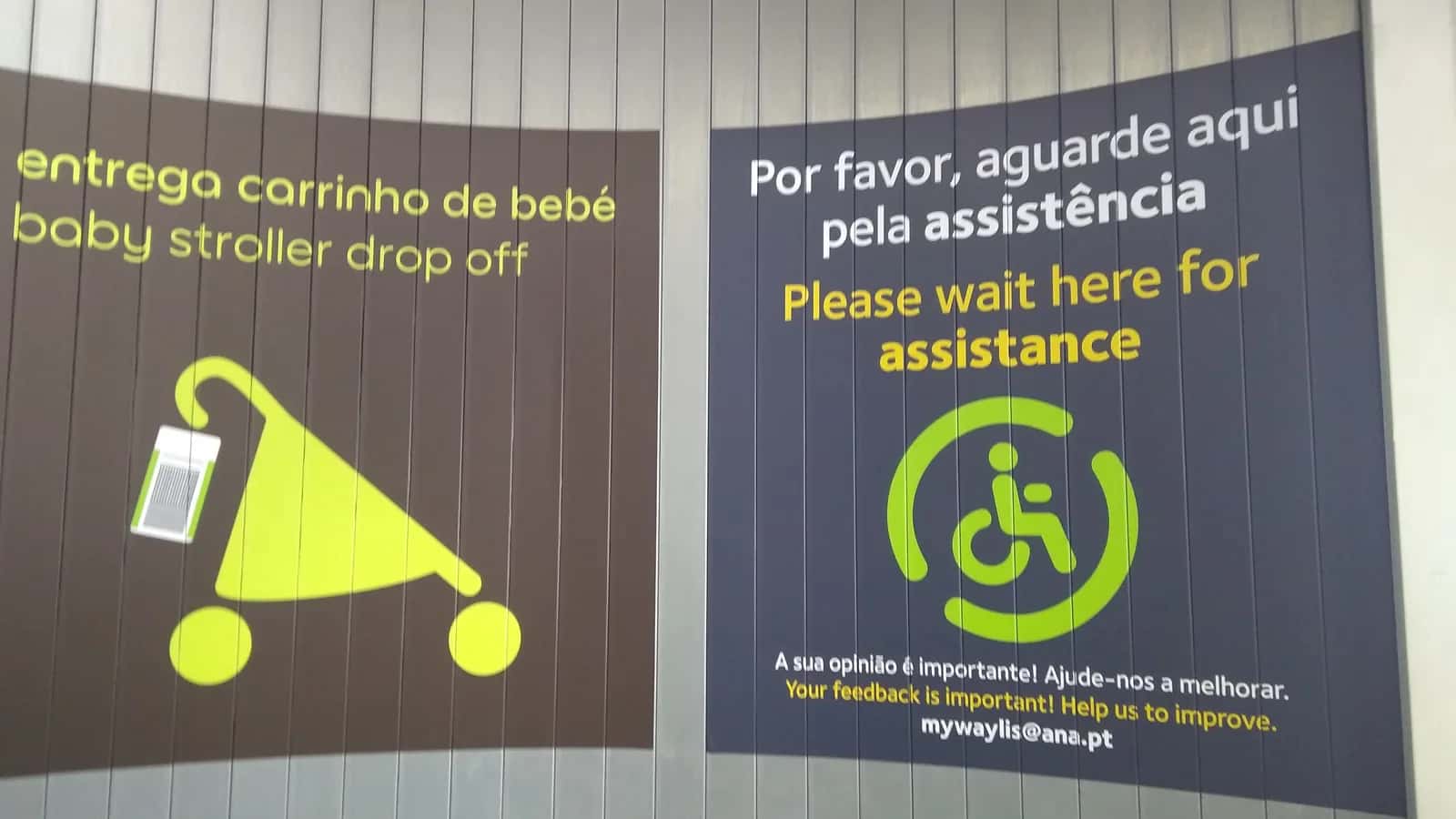
Lisbon Airport is generally family-friendly, with several specific provisions for travellers with young children. Both terminals have designated family bathrooms with changing tables, baby-friendly nursing rooms (with private feeding spaces), and stroller-accessible areas throughout. Most major airlines allow families with young children to board priority, and family-friendly fast-track lanes for security exist at most terminals though they may not always be prominently signposted — ask staff if you don't see them.
For long layovers with children, T1 has a children's play area near the main gate concourse, with soft play equipment suitable for younger children. T2's family facilities are more modest but still functional. Free strollers are not widely available — bring your own or rely on airline-provided ones for boarding. Children's meal options are available at most major restaurants, and several cafés have high chairs.
For travelling with infants, breastmilk and baby food can pass through security in larger quantities than the standard 100ml liquid restriction allows; explain at the security checkpoint and these items will typically be screened separately. Bottles can be warmed at most cafés and restaurants if requested. For families flying with TAP, complimentary in-flight meals and entertainment for children are typically provided on long-haul flights; for low-cost flights from T2, plan to bring your own snacks and entertainment.
Accessibility Services at LIS
ANA operates a comprehensive accessibility programme at all Portuguese airports including LIS. The service is free to passengers who request it in advance through their airline at least 48 hours before travel, though it can sometimes be arranged at shorter notice. Services include wheelchair assistance, escort through the airport, help with luggage, priority boarding, and assistance during connections. Trained staff are available throughout the airport's operational hours.
The airport infrastructure is designed with accessibility in mind, with elevators between all levels, accessible bathrooms, lowered counters at check-in, accessible parking, and audio/visual announcement systems. Service animals are welcome with appropriate documentation. For travellers with hearing impairments, T1 has audio loop systems at many information desks and gates. Visual impairment support includes tactile floor markings at major decision points and audio cues at elevators and gates.
For travellers with mobility issues using wheelchairs, the inter-terminal transport is fully accessible, with the shuttle bus equipped to handle wheelchairs and trained staff available to assist. Request airside assistance from your airline if you have connecting flights between terminals, as the staff can often arrange dedicated transport rather than the standard shuttle bus. ANA's accessibility helpline can answer specific questions about the airport's facilities and services in advance of travel.
Travel Apps and Digital Tools for the Airport
Several digital tools enhance the LIS experience. The official ANA Aeroportos app provides real-time flight information, terminal maps, walking time estimates between gates, and amenity locations. The app is available in Portuguese and English and is genuinely useful for navigation, particularly for first-time visitors. The app also provides notifications about flight changes and delays, which can be more responsive than the public-facing displays.
TAP Portugal's app is similarly polished for passengers flying with that carrier — it handles check-in, boarding pass storage, baggage tracking, and seat selection, and integrates with airport navigation in T1. Other major airlines at LIS have their own apps with varying degrees of integration. For ground transportation, the Metro de Lisboa app, the CP (Comboios de Portugal) app for trains, and ride-hailing apps (Uber, Bolt) all have substantial coverage of the airport and the broader Lisbon area.
Translation apps are useful for non-Portuguese speakers, though English is widely spoken at the airport. Currency conversion apps help with on-the-spot purchase decisions. For long layovers, downloading entertainment in advance is wise, as airline streaming services may not always work reliably and the airport WiFi, while functional, is not always fast enough for high-quality video streaming. Several "lounge access" apps (LoungeKey, Priority Pass, etc.) help travellers with appropriate credit cards or memberships find which lounges accept their access.
Common Mistakes Travelers Make at Lisbon Airport
Several mistakes recur frequently among travellers at LIS, and avoiding them can save significant frustration. The most common is underestimating the time needed to transfer between T1 and T2 — assuming the shuttle bus is quick or always immediately available leads to missed connections. Build in 60 minutes minimum between flights at different terminals, more during peak times.
Another frequent mistake is showing up too early or too late. Arriving 4 hours before a flight gives you significant idle time at the airport (which has good amenities but isn't designed as a destination); arriving an hour before a flight is risky during peak season. The 2-3 hour window covers most situations comfortably. Similarly, assuming the Lisbon metro will get you to the airport in 15 minutes from any city centre location is optimistic — plan for 25 to 35 minutes from central Lisbon by metro, including transfers.
Forgetting that many small purchases (water, snacks) at airport restaurants are significantly more expensive than at city centre prices is another common surprise. Bringing an empty water bottle to refill from drinking fountains (available throughout the airport) saves money and reduces single-use plastic. Misunderstanding terminal assignments — particularly assuming all flights to certain destinations leave from T1 — leads to confused arrivals at the wrong building. Always confirm your terminal at check-in or via your boarding pass before travelling to the airport. The handy Lisbon Airport parking services guide can save you money if you book in advance.
Tips for First-Time Visitors
If this is your first arrival at LIS, several practical tips help orient you. First, the airport's signage is multilingual (Portuguese, English, sometimes Spanish, French, and others depending on terminal area), and following signs is generally reliable. Second, ground transport is well-connected and frequent — you don't need to immediately rush to your hotel; take a moment in the arrivals hall to get oriented, withdraw cash if needed, and confirm your transport plan.
For getting to the city, the Metro Red Line is the cheapest option at €1.90 (plus a one-time card fee for the rechargeable Viva Viagem card), with a direct connection from the Aeroporto station at T1 to central Lisbon in about 25 minutes via Alameda or Saldanha for transfers to other lines. Taxis from LIS use the meter and typically cost €15 to €20 to central Lisbon depending on traffic and final destination — significantly cheaper than equivalent journeys from major European hubs.
For a first stay in Lisbon, consider the airport's proximity as an advantage. Even with arrivals fatigue, central Lisbon is easily accessible, and many travellers go straight to their hotel or even a quick early-evening drink at a rooftop bar without needing to rest first. If you're departing on an early morning flight, the proximity also means hotels in central Lisbon are often perfectly viable choices rather than requiring an airport-area hotel — a 30-minute taxi or metro ride at 5:00 AM is manageable. Find a great place to stay through our hotels near LIS guide.
Lastly, embrace some Portuguese hospitality and cuisine while you're at LIS — even with limited time, a quick pastéis de nata (custard tart) and bica (espresso) at one of the airport cafés is the right introduction to Portugal. If your trip involves a longer wait, consult the layover at Lisbon Airport guide for ideas on making the most of the time, including the option of leaving the airport entirely to explore central Lisbon during longer layovers. For travellers who prefer pre-arranged transport, our coverage of Lisbon Airport transfers covers private and shared options. And if you need to reach the city centre quickly, see our specific guide on how to get from Lisbon Airport to city centre.
Need help planning? Get in touch
You May Also Like
- Lisbon Airport Terminals (T1, T2)
- Airlines at Lisbon Airport
- How to Get from LIS to Lisbon City Centre
- Making the Most of a Layover at LIS
Update (2023): The Aerobus shuttle service (formerly aerobus.pt) was discontinued. Carris urban bus lines 783, 728, 744 and 24-hour night line 208 now provide all public airport–city connections at €2.30 per ride.