Transportation from Lisbon Airport to Train Station
For many travelers passing through Humberto Delgado Airport, the journey does not end at the terminal door. Lisbon is the gateway to the rest of Portugal — and to a lesser extent, to mainland Europe — and a substantial share of arriving passengers continue immediately by train. Whether you are heading north to Porto on the high-speed Alfa Pendular, south to Faro and the Algarve, west to Cascais along the coast, or onward to regional destinations like Évora, Coimbra, or Sintra, the connection from Lisbon Airport (LIS) to the appropriate train station is one of the more important pieces of trip planning.
The good news is that Lisbon's airport-to-rail connections are well organized. The Metro Red Line runs directly from the airport to Oriente Station, the city's most important rail hub for long-distance and international services, in roughly five minutes. Other stations — Santa Apolónia, Rossio, Cais do Sodré, and Entrecampos — are reachable via Metro transfers, Carris bus 783, taxis, or ride-hailing, with each option offering its own balance of cost, speed, and convenience.
This guide walks through every train station relevant to airport travelers, the rail services that operate from each, and the precise transport options for getting from your arrival gate at Lisbon Airport to the platform you need. It also covers timing, baggage, accessibility, and the small practical realities — buying tickets, finding the right platform, dealing with delays — that turn a potentially stressful connection into a routine one.
Lisbon's Train Stations — An Overview
Lisbon has four primary train stations, each with a distinct role in the country's rail network. Understanding which station serves your onward destination is the essential first step. Booking a high-speed Alfa Pendular service to Porto from the wrong station will simply not work — these services run from specific stations only, and the onward journey from a station that does not serve your route can be considerable.
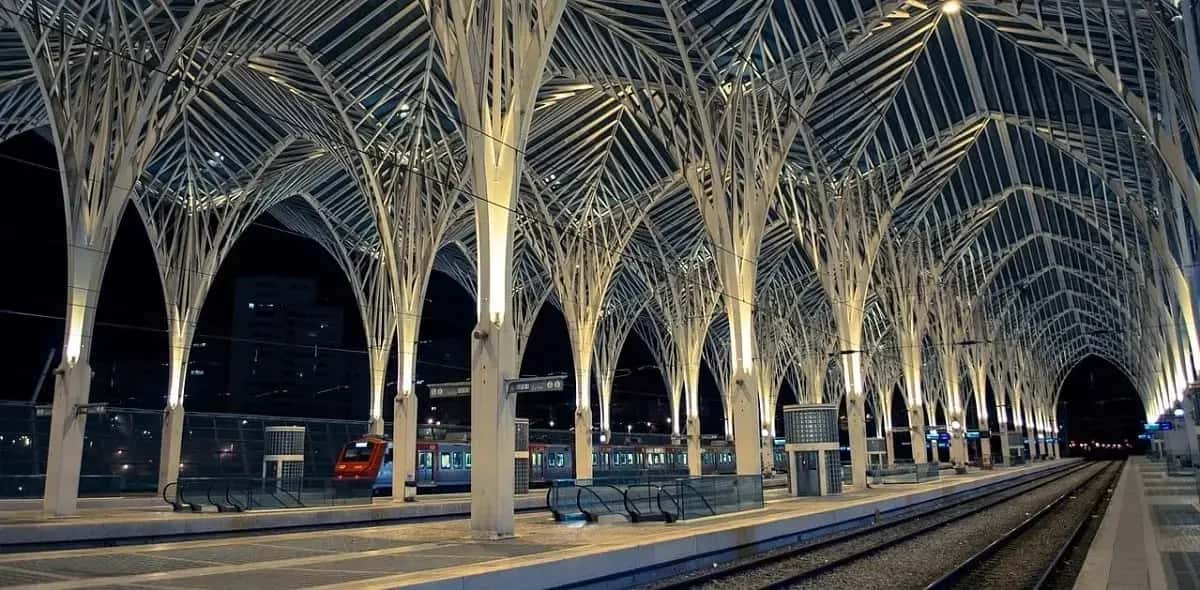
Oriente Station (Estação do Oriente, also called Gare do Oriente) is the most modern and one of the most important — designed by Santiago Calatrava and opened for Expo '98, it serves long-distance domestic services, international trains to Spain, and regional commuter services. It is the closest major station to the airport in both distance and Metro travel time.
Santa Apolónia is the historic main terminus of Portugal's railways, located near Alfama on the Tagus riverfront. It serves long-distance trains to Porto and the north, as well as some international services, and is a terminus on the Metro Blue Line. Rossio Station, a beautiful Manueline-style building in the heart of central Lisbon, primarily serves the Sintra Line — the suburban service that connects to UNESCO-listed Sintra. Cais do Sodré, on the western edge of central Lisbon, is the terminus of the Cascais Line that runs along the Tagus to the seaside resorts of Estoril and Cascais.
Two additional stations are worth knowing about: Entrecampos in northern Lisbon, which handles some regional and Alentejo-bound services and connects to the Yellow Metro Line, and Sete Rios, near the zoo, which is primarily a bus terminal but also serves some regional trains. For most international airport travelers, however, Oriente and Santa Apolónia are the two stations that matter most.
Oriente Station — The Main Long-Distance Hub
Oriente is the station most airport travelers will use, and for good reason. It serves the widest range of long-distance Portuguese services — including the Alfa Pendular high-speed trains to Porto, Coimbra, Aveiro, and Braga — and is the Lisbon terminus of the international Celta service to Vigo in Spain (currently suspended at times for engineering work, so check current status before relying on it). It also serves regional Intercidades trains to the Algarve, Évora, and Beja, and is a major commuter hub for the Sintra and Azambuja suburban lines.
Oriente is just three Metro stops from the airport on the Red Line, with a journey time of approximately five minutes. The station is fully integrated with the Metro — you simply walk from the Metro platforms up into the rail station's main concourse, where you'll find ticket machines, staffed CP (Comboios de Portugal) ticket counters, departure boards, restaurants, cafés, and shops. The whole space is open and architecturally striking, which makes it pleasant to spend time in if you have a wait.
For travelers connecting to Porto via the Alfa Pendular, Oriente is typically the more convenient option compared to Santa Apolónia. While the Alfa Pendular runs from both stations, Oriente offers easier airport access, more departures throughout the day, and better connections to the wider Metro network. The journey to Porto Campanhã takes about three hours on the AP, with stops at major intermediate cities. Tickets can be bought online at cp.pt up to several months in advance, with significant discounts for early booking — sometimes more than half off the walk-up price.
Practical tip: arrive at Oriente at least 15-20 minutes before your train. The platforms are not within sight of the main concourse, and you'll need time to find the right one, descend or ascend (depending on whether your train is local or long-distance), and validate your ticket if it's a regional fare. For longer-distance Alfa Pendular and Intercidades services, seat reservations are mandatory and printed on your ticket — make sure you board the right carriage.
Santa Apolónia — Historic Terminus and Northern Gateway
Santa Apolónia is Lisbon's oldest active station, opened in 1865, and it remains an important terminus for long-distance services to northern Portugal. Many Alfa Pendular and Intercidades trains to Porto either originate here or call here after leaving Oriente — though increasingly, services start at Oriente and skip Santa Apolónia entirely, so always check your specific train's stops.
From the airport, the most direct way to reach Santa Apolónia is via Metro. Take the Red Line from the airport to Alameda (six stops, about 12 minutes), then transfer to the Green Line and ride to Santa Apolónia (six more stops, about 13 minutes). The total journey including transfer time is approximately 30-35 minutes — slower than the direct Red Line trip to Oriente. The single Metro ticket at €1.90 covers the whole journey provided you don't leave the paid area between transfers.
An alternative is Carris bus 783 91, which runs between the airport and central Lisbon stopping near Santa Apolónia (the Praça do Comércio stop is a 10-minute walk along the riverfront from the station).
Taxis from the airport to Santa Apolónia typically cost €15-20 and take 15-25 minutes depending on traffic. Ride-hailing services (Uber, Bolt, Free Now) are usually a few euros cheaper. For travelers with multiple bags, late-night arrivals, or tight onward connections, a taxi or rideshare is often the simplest choice despite the higher cost.
Santa Apolónia's facilities include a CP ticket office, ticket machines, a small selection of cafés and shops, restrooms, and connections to bus services and ferries across the Tagus. The station building itself is worth a quick look — its 19th-century interior retains much of its original character.
Rossio Station — Connecting to Sintra
Rossio Station is the smallest of central Lisbon's main stations but one of the most architecturally beautiful — its Manueline horseshoe-arch facade is a landmark of Praça do Rossio, in the heart of the Baixa district. Operationally, Rossio's primary role today is as the Lisbon terminus of the Sintra Line, the suburban rail service connecting central Lisbon to the UNESCO World Heritage town of Sintra.
Sintra is one of the most popular day trips from Lisbon, and many travelers visit it directly from the airport on arrival or departure days. The journey from Rossio to Sintra takes 40-45 minutes on the suburban train, with departures every 15-30 minutes during the day. A single ticket costs around €2.30, and the Viva Viagem reusable card is the most economical way to pay if you're making multiple journeys.
Getting from the airport to Rossio is a two-stage process: take the Red Line Metro to Alameda, then transfer to the Green Line and ride two stops to Rossio. The total Metro journey is approximately 25-30 minutes. Alternatively, Carris bus 783 91 stops at Restauradores, a five-minute walk from Rossio Station. The Metro option is typically the most reliable and cheapest, and the Sintra Line trains depart from platforms inside Rossio Station.
For travelers planning to visit Sintra immediately after a flight arrival, consider whether the timing actually works — Sintra's main attractions (Pena Palace, Quinta da Regaleira, Moorish Castle) typically take 4-6 hours to visit properly, and arriving at Rossio in mid-afternoon may leave you rushing. Many travelers find it more sensible to spend the arrival day in Lisbon and visit Sintra on a subsequent full day.
Cais do Sodré — The Cascais Line
Cais do Sodré is the terminus on the Tagus riverfront for the Cascais Line, the suburban railway running west along the coast to Estoril and Cascais. The line is one of Lisbon's most scenic short rail journeys, with views of the river and Atlantic for much of the route, and is the standard way for travelers to reach the seaside resorts that line the coast outside the city.
From the airport, getting to Cais do Sodré requires a Metro transfer. Take the Red Line to São Sebastião (eight stops, about 15 minutes), then transfer to the Blue Line and ride two stops to Restauradores or three stops to Baixa-Chiado. From either of these, Cais do Sodré is a short walk or one additional stop on the Green Line via Baixa-Chiado. Realistically, the total journey from the airport to Cais do Sodré is 35-45 minutes by Metro, including transfers.
Carris bus 783 91 has a stop at Cais do Sodré — its terminus, in fact — making it an attractive option for travelers heading directly to the Cascais Line. Carris bus 783 journey is 30-45 minutes depending on traffic and includes a stop at Cais do Sodré that drops you essentially at the entrance to the rail station. For travelers with luggage planning to continue to Cascais immediately, Carris bus 783 is often the simplest single-transfer option.
For more on the journey to Cascais specifically — including timing, beach resort options, and tips on what to do upon arrival — see our dedicated guide to getting from Lisbon Airport to Cascais. The 40-minute coastal train journey is one of the most enjoyable parts of arriving in the Lisbon region for travelers heading to the resort towns.
Entrecampos and Sete Rios — Regional Connections
Entrecampos Station, in the Avenidas Novas district of north-central Lisbon, has grown in importance in recent years as a stop for some long-distance and regional services. It serves Intercidades trains to the Alentejo region (Évora, Beja) and is a useful stop for travelers headed to inland southern Portugal. The station connects to the Yellow Metro Line, which intersects with the Red Line from the airport at Saldanha.
From the airport to Entrecampos, take the Red Line to Saldanha (five stops, about 10 minutes), then transfer to the Yellow Line and ride one stop to Entrecampos. Total Metro time is around 15-20 minutes. Alternatively, you can stay on the Red Line and ride one more stop to Entrecampos, which is a Red Line station as well — though the rail station itself is reached via a slightly different exit.
Sete Rios is primarily a bus terminal (the main one for long-distance buses departing Lisbon for destinations across Portugal and into Spain), but it also has a small rail station on the Sintra Line. For most airport travelers, Sete Rios is more relevant as the destination if you're connecting to a long-distance bus rather than a train. The station is on the Blue Metro Line, accessible from the airport by transferring at São Sebastião.
Other regional rail destinations — including direct-line services to small Alentejo towns or to Coimbra — typically depart from Oriente, so for the majority of regional travel needs, the simple direct Red Line to Oriente remains the right answer.
From Lisbon Airport to Oriente — The Direct Route
Of all the airport-to-station connections, the journey to Oriente is by far the simplest. The Metro Red Line (Linha Vermelha) runs directly from Aeroporto Station, the airport terminus, to Oriente, with the journey taking approximately five minutes including stops. Trains run every five to ten minutes throughout the day, with somewhat reduced frequency in the late evening.
The Aeroporto Metro station is located beneath Terminal 1 (T1), reached via clearly signed elevators and escalators from both the arrivals hall and the departures level. Follow signs marked "Metro" — they're placed at regular intervals throughout the terminal and are bilingual in Portuguese and English. The station has ticket machines accepting cards and cash, plus staffed counters during operating hours.
Tickets cost €1.90 for a single Metro fare, payable via the Viva Viagem rechargeable card (€0.50 deposit) or the new Navegante touch-pay system. If you'll be using public transport in Lisbon during your stay, the daily Viva Viagem (€7.25) or the 24-hour combined ticket (also €7.25) covering Metro, buses, and trams is excellent value. For travelers connecting straight to a long-distance train without exploring Lisbon, the single fare is sufficient.
From the airport, take the Red Line in the direction of São Sebastião — every train on the line goes to Oriente as it's the third stop. Listen for the announcement or watch the platform displays. At Oriente, follow exit signs upward; the station is a multi-level structure with rail platforms above the Metro level. Allow yourself five minutes to navigate from the Metro arrival to the rail platforms, more if you're unfamiliar with the station.
From Lisbon Airport to Santa Apolónia — Metro vs Carris airport bus vs Taxi
The journey to Santa Apolónia involves more decisions than the simple ride to Oriente. Three main options exist, and the right one depends on your luggage, time constraints, and budget.
The Metro option is the most economical at €1.90. From Aeroporto, take the Red Line six stops to Alameda, then transfer to the Green Line and continue six stops to Santa Apolónia (the terminus). Total journey time is approximately 30 minutes including transfer. The Metro is reliable and runs every five to ten minutes during the day, but managing luggage on stairs and through crowds at peak hours can be tiring. Both Alameda and Santa Apolónia stations have step-free access via elevators, but they're sometimes crowded.
The bus stops near Santa Apolónia at Praça do Comércio — it's about a 10-minute walk along the Tagus riverfront from there to the station entrance. Carris bus 783 journey is 30-45 minutes depending on traffic, with the post-bus walk adding to total time, but the comfort of having luggage onboard rather than on stairs is a real advantage.
Taxis or rideshares (Uber, Bolt, Free Now) provide direct service for €15-20 with a journey time of 15-25 minutes. The taxi option works well for travelers with significant luggage, late arrivals when Metro frequency drops, or tight onward connections where the time savings justify the cost. Have your destination address ready in writing for the driver — "Santa Apolónia Station" is universally understood, but the specific entrance you need (main entrance versus side platforms) can save additional walking.
Practical timing: if your onward train departs Santa Apolónia within 60 minutes of your flight arrival, prioritize a taxi for predictable travel time. If you have 90+ minutes, the Metro is fine and saves €15.
From Lisbon Airport to Rossio — The Sintra Connection
Reaching Rossio Station from the airport is straightforward but involves a Metro transfer. The standard route is Red Line to Alameda (six stops, 12 minutes), then Green Line to Rossio (two stops, four minutes). Total Metro time is approximately 20-25 minutes including the transfer at Alameda, where the Red and Green lines cross at right angles in a multi-level station with clear signage.
Rossio Station has its own Metro entrance directly inside the rail station's lower level, so once you arrive on the Green Line you walk a short distance to reach the rail platforms. Trains to Sintra depart from platforms 4-6, with services running every 20-30 minutes during the day. The journey to Sintra takes 40-45 minutes, ending at Sintra Station near the historic center.
The alternative is Carris bus 783 91, which has a stop at Restauradores about five minutes' walk from Rossio. This adds Carris bus 783's longer travel time (30-45 minutes) but spares you the Metro transfer. Most travelers heading to Sintra find the Metro route more efficient overall.
If you're aiming to reach Sintra during a single travel day, leaving from the airport, factor in the cumulative time: 25 minutes airport to Rossio, plus waiting for the next Sintra train (up to 30 minutes), plus the 45-minute train journey. Total: roughly 90-100 minutes from arrival hall to Sintra Station, plus walking time to attractions. Plan accordingly.
Buying Tickets — At Stations and Online
Portugal's national rail operator, CP (Comboios de Portugal), sells tickets through multiple channels. For long-distance services like Alfa Pendular and Intercidades, online booking at cp.pt is strongly recommended — it offers the widest selection of seats, advance-purchase discounts that can be substantial, and the convenience of a printed or mobile ticket without queueing.
The CP website and mobile app are functional but occasionally slow or temperamental — be patient if a booking attempt fails initially, and try again. Tickets are issued as PDFs by email and via the app's mobile ticket display. Either format is accepted at boarding, where conductors check tickets electronically. International credit cards are accepted, though some travelers report occasional issues with American Express; Visa and Mastercard work reliably.
At stations, tickets can be bought from staffed counters (typically with English-speaking staff at major stations) or from automated ticket machines. The machines accept cards and cash and have English-language interfaces, but they can be confusing for first-time users — be prepared to queue at the staffed counters for assistance with complex itineraries or international connections.
For Metro tickets within Lisbon (including the airport-to-Oriente journey), the simplest approach is the Viva Viagem rechargeable card sold at airport Metro vending machines for €0.50, then loaded with as many single tickets or daily passes as you need. The card stays with you for future Lisbon visits and integrates with all of the city's transport (Metro, Carris buses and trams, Cascais and Sintra Lines, ferries).
Connecting to Porto — The Alfa Pendular
The Alfa Pendular (AP) is Portugal's flagship train service, connecting Lisbon to Porto in approximately three hours via a tilting train that maintains 220 km/h on suitable sections of track. It's a comfortable journey through the central Portuguese countryside, with stops at Coimbra B (the major university city), Aveiro, and Vila Nova de Gaia/Porto Campanhã.
From Lisbon, AP services run from Oriente and Santa Apolónia, with most trains calling at both. Departures are roughly hourly during the day, with eight to ten services daily in each direction. Tickets in advance start from around €25 in Tourist class for early bookings; the same fare can rise to €40-50 closer to travel. Comfort class (first class) costs roughly 50% more and includes wider seats, more legroom, complimentary refreshments, and access to a lounge in larger stations.
For airport travelers, taking the Red Line to Oriente and boarding the AP there is by far the simplest approach. From flight arrival to onward train departure, allow at least 75 minutes for the Metro journey, ticket purchase or pickup, finding the platform, and boarding. With pre-booked tickets and a tighter schedule, 60 minutes is feasible if everything goes smoothly, but international flight delays or longer-than-usual Metro waits can compromise tight connections.
The AP arrives in Porto at Campanhã station, on the eastern edge of the city. From there, suburban or Intercidades trains continue to Porto's central São Bento station (the historically photographed one with the blue-and-white tile interior), four minutes away on a frequent shuttle service. Many travelers' final destinations are reached more easily from São Bento, so factor in this final leg when planning.
Connecting to the Algarve — Faro, Albufeira, and the Southern Coast
The Algarve, Portugal's southern coast, is connected to Lisbon by the Intercidades (IC) service, which runs from Oriente Station with several departures daily. The journey to Faro, the regional capital, takes around three hours direct, with intermediate stops including Pinhal Novo, Tunes (the gateway to Albufeira), and Loulé. Most westbound destinations along the Algarve coast — Lagos, Portimão, Albufeira, Carvoeiro — require a transfer at Tunes.
IC tickets to Faro start at around €22 in advance for Tourist class and run higher closer to travel. The service is comfortable but slower than the AP — single-deck regional cars rather than tilting trains — and the route is less scenic than the Lisbon-Porto journey. Many travelers choose to fly directly to Faro Airport rather than train south, but for those starting in Lisbon, the train remains a reliable option.
From the airport, the journey is similar to Porto: Red Line Metro to Oriente, then board the Intercidades. Allow 75-90 minutes for the connection. Carriage assignment is printed on the ticket; conductors check during the journey. Tunes, the transfer point for western Algarve destinations, has a separate platform for connecting suburban trains, with reasonable wait times of 15-30 minutes between connections.
For travelers staying in beach resorts, ride-hailing or pre-booked transfers from Faro or Albufeira stations to specific resort accommodation are usually necessary, as the train stations are not always within walking distance of resort properties.
International Trains from Lisbon
Portugal's international rail connections are limited but exist. The Celta service to Vigo in northern Spain runs from Oriente Station (currently subject to engineering works affecting some services — always check current operations before booking). The journey takes about 4-5 hours through scenic northwestern Portugal and Galicia.
The Lusitania night train to Madrid was suspended in recent years and has had only intermittent service. As of late 2025/early 2026, options for direct Lisbon-Madrid rail travel are limited; most travelers fly the route, take a connecting bus through cities like Évora or Badajoz, or use the longer combined train-bus options. Check current CP and Renfe (the Spanish operator) websites for up-to-date service availability.
For travelers planning multi-country European rail journeys, Lisbon is more often a destination than a major waystation. The peninsula's geographic isolation from the rest of Europe, combined with limited current rail infrastructure, means that international flights remain the more practical option for most onward connections beyond Spain.
That said, EuroRail and Interrail passes are valid on Portuguese rail services, and travelers using these passes can ride the AP, IC, and regional services. Mandatory seat reservations on AP and some IC services cost a small additional fee even with a rail pass.
How much time should you allow?
For onward train connections, build in generous time buffers — far more than you'd want for connecting flights at a hub. Train delays are less common than flight delays in Portugal but they do happen, particularly during summer fire seasons and winter weather events. More importantly, the airport-to-station journey itself can vary: Metro delays, traffic for Carris 208 night bus or a taxi, baggage delays at the airport — any of these can compress your buffer.
Recommended minimums from flight arrival at Lisbon Airport to onward train departure:
For the Red Line direct to Oriente Station and an Alfa Pendular or IC departure: 75 minutes from wheels-down to train departure. This assumes a standard arrival without significant baggage delays, walking time through the airport, and modest Metro delays.
For Santa Apolónia connections requiring Metro transfers or Carris airport bus: 90 minutes minimum, ideally 105 minutes. The transfer at Alameda adds variance.
For Sintra Line connections via Rossio: 90 minutes minimum, with the same Alameda transfer factor.
For long-distance Cascais Line connections via Cais do Sodré: 90-105 minutes, accounting for the multi-Metro-transfer journey or the slower Carris airport bus.
For travelers connecting from international flights with significant baggage, consider increasing buffers by 15-30 minutes. Adding €15-20 for a taxi rather than the Metro is often worth the predictability when timing is tight.
Accessibility on Lisbon Trains
Portuguese rail accessibility has improved significantly over the past decade. Major stations including Oriente, Santa Apolónia, and the principal stops on the Cascais and Sintra Lines have step-free access via elevators. Modern Alfa Pendular and Intercidades trains have wheelchair-accessible spaces in specific carriages, with on-train staff trained to assist passengers in boarding and disembarking.
For long-distance services, advance arrangement for accessibility assistance is strongly recommended — contact CP at least 48 hours before travel via their accessibility service line or website. Suburban and regional trains have varying levels of accessibility; the more recent rolling stock on the Cascais and Sintra Lines is fully accessible, while older equipment on some regional services is less so.
Travelers using wheelchairs or with reduced mobility heading from the airport to a long-distance train should consider private transfer or taxi options rather than the Metro, which involves elevators and platform-train gaps that may be challenging. The cost difference is often justified by the smoother journey, particularly with travel companions and luggage.
At Oriente specifically, the Metro-to-rail transition is largely step-free, with elevators between levels well-marked and reasonably reliable. Staff at the station's information point can provide directions and assistance, though English-language coverage is good rather than guaranteed at off-peak hours.
Luggage Tips
Trains in Portugal handle luggage well, but the practical realities of moving with multiple bags between airport, Metro, and rail platforms favor planning ahead. The airport's Metro station has step-free access via elevators from the terminal level, so you can avoid stairs entirely on departure. At Oriente, the Metro-to-rail transition is also largely step-free, though some routes through the station involve escalators or short staircases.
Long-distance trains have luggage racks at the ends of each carriage, with space for two to four large suitcases per group. Smaller bags fit in overhead racks above seats. For very large luggage or sports equipment, contact CP in advance to confirm space; some equipment requires a specific reservation.
Carris bus 783 accepts luggage in the underbus storage area, with passengers typically handling their own bags. For travelers with more than two large bags, Carris bus 783 is comfortable but the post-arrival walk to your station entrance (Santa Apolónia from Praça do Comércio) can be tiring with luggage.
If you're concerned about luggage management, taxis or rideshares simplify the journey considerably — driver assistance with bags is standard, and you arrive directly at the station entrance. For a couple traveling together with three or four bags total, the €15-20 taxi fare often represents a sensible investment in convenience.
Late-Night and Early-Morning Travel
The Metro operates from approximately 06:30 to 01:00, with reduced frequency in the late evening (every 10-15 minutes rather than every five). The Red Line to Oriente runs throughout this window, so most early-morning and late-evening train connections work fine via Metro.
Outside Metro hours, the options are more limited. For genuinely overnight transitions — a 02:00 flight arrival heading to a 06:00 train, for example — taxi or rideshare is the only realistic option. Both run 24 hours from the airport, with some additional surcharge between 21:00 and 06:00 (roughly 20% extra) and on Sundays/holidays.
Trains themselves operate primarily during daytime and early evening. The first AP services typically depart around 07:00, with the last around 21:00. There is essentially no overnight rail service within Portugal anymore — the suspended Lusitania to Madrid was the last regular long-distance overnight train. Plan your onward journey assuming daytime travel.
For travelers with very early train departures (06:00-07:00), spending the previous night at an airport-area hotel and taking a short morning taxi to Oriente is often more sensible than navigating the very early Metro service from anywhere in the city.
Practical Tips for Onward Train Travel
A few small details improve the experience of connecting from airport to train. Validate your CP ticket before boarding if it's a regional fare from a vending machine — modern AP and IC tickets bought online are pre-validated, but some regional and suburban tickets require stamping in the yellow machines on platforms. The conductor will help if uncertain, but uncertain tickets can cause issues.
Buy a SIM card or activate a mobile data plan before boarding the train if you'll need internet — train Wi-Fi exists on AP services but is unreliable, particularly when the train passes through tunnels or remote sections of track. If you'll be navigating to your final destination upon arrival in Porto, the Algarve, or wherever, having mobile data ready makes the process easier.
Carry water and a snack. The AP and IC services offer onboard café service, but it can be slow during peak times and the selection is limited. A simple bottle of water and a sandwich from one of the airport convenience stores or Oriente Station's shops costs less than the train café and ensures you're not hungry mid-journey.
Save your ticket and any reservation confirmations to your phone offline, in case Wi-Fi or data fails when you need to display them. The CP app stores tickets but requires login — having a screenshot or downloaded PDF as backup is sensible insurance against connectivity issues.
For families with children traveling on long-distance trains, AP and IC services have toilets in every carriage and a simple café service. Children's discounted fares apply with valid identification. Stroller storage is available in the wheelchair-accessible spaces if not in active use; ask conductors for guidance.
If you encounter a missed connection due to flight delay, CP staff at Oriente can usually reissue tickets for the next available service in the same fare class without an additional charge if the original journey was clearly impossible to make. Have your boarding pass and flight delay documentation ready. This isn't a guarantee, but in practice it works for clearly external causes outside your control.
Connecting to onward trains? Get in touch
You May Also Like
- Lisbon Airport Metro
- Lisbon Airport Transfers
- Transportation from Lisbon Airport to Cascais
- How to Get from Lisbon Airport to City Center
Update (2023): The Aerobus shuttle service (formerly aerobus.pt) was discontinued. Carris urban bus lines 783, 728, 744 and 24-hour night line 208 now provide all public airport–city connections at €2.30 per ride.